Japandi Interior Design: The Complete Style Guide
Japandi is the dominant interior design style of 2026. This complete guide covers the philosophy, the palette, the furniture, the materials, and how to apply Japandi to every room — with AI tools that show the result in your actual space.
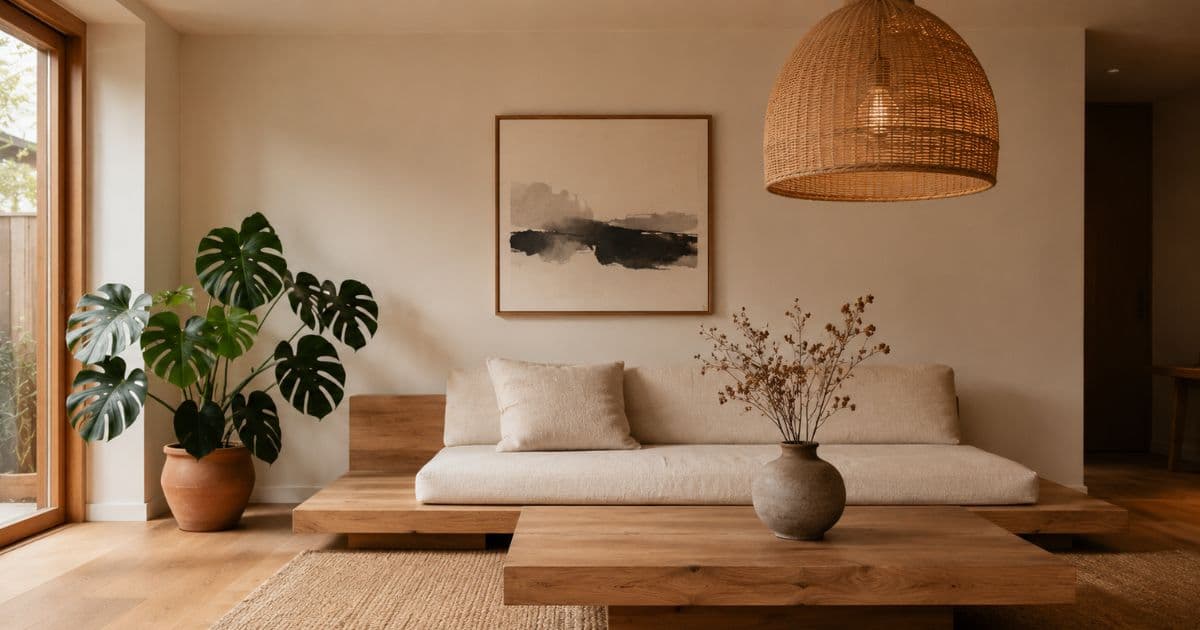
Japandi is the dominant interior design style of 2025 — and it has been for three consecutive years. It's not a trend that appeared suddenly. It's a convergence of two parallel design philosophies that independently arrived at similar conclusions about how a home should feel: calm, functional, natural, and deeply human.
Understanding Japandi properly — not just the aesthetic, but the underlying philosophy — is the difference between a room that looks Japandi and a room that feels it.
What Japandi Is (And What It Isn't)
A hybrid of two design traditions that share more DNA than they differ.
Japandi is a contraction of Japanese and Scandinavian — two design philosophies that emerged independently from remarkably similar values.
Japanese design principles:
- Wabi-sabi — finding beauty in imperfection, impermanence, and incompleteness
- Ma — the deliberate use of negative space as a design element
- Kanso — simplicity achieved through elimination of the unnecessary
- Shibui — quiet, subtle beauty that reveals itself over time
Scandinavian design principles:
- Lagom — "just the right amount" — balance and restraint
- Hygge — the quality of coziness and comfort in a space
- Function first, then form — every object earns its place through use or genuine beauty
Where they converge: both traditions value natural materials, restrained decoration, functional beauty, and the idea that a home should create a sense of calm rather than stimulation.
What Japandi isn't: cold minimalism. The visual similarity between Japandi and clinical modern minimalism misleads people into thinking the two are related. They're not. Minimalism eliminates for the sake of visual clarity. Japandi eliminates for the sake of meaning — each object that remains carries weight.
The Japandi Palette
Warm-neutral, earthy, and consistent — never cool or stark.
The Japandi palette operates in the warm-neutral zone: tones that read as neither white nor grey, but instead suggest earth, bark, stone, and organic material.
| Palette Category | Colors |
|---|---|
| Base neutrals | Warm white, oatmeal, warm linen, warm greige |
| Earthy accents | Dusty sage, warm terracotta, muted olive, warm charcoal |
| Natural timber tones | Warm oak, walnut, bamboo |
| Muted darks | Charcoal, warm black (never cool grey or pure white) |
What distinguishes Japandi palette from generic neutral palettes: the warmth. Every tone has a warm undertone — no cool greys, no pure whites, no blue-tinted neutrals. The warmth is what creates the sense of calm rather than sterility.
The test: if your neutral reads as slightly grey or blue under natural light, it's not Japandi. If it reads as slightly beige or warm sand, it is.
Japandi Furniture
Low, natural, simple, and made from genuine materials.
The Bed
The Japandi bed is low to the floor — a platform bed or a low-profile frame in natural oak or walnut. The headboard, if present, is simple: upholstered in linen or natural fabric, with no ornament.
What's on the bed: white or oatmeal linen duvet, white or oatmeal pillowcases, a maximum of two or three cushions. Nothing matching. Nothing decorative for the sake of decoration.
The Sofa
Low profile, generous but not oversized, upholstered in natural linen or textured fabric in a neutral tone. No pattern, no print. Legs in natural timber if visible.
What's on the sofa: a maximum of three cushions in natural fabrics, one quality throw.
Tables and Storage
Natural timber — oak, walnut, or bamboo. Clean lines, no ornament. Every storage piece earns its place by being genuinely useful.
The golden rule for Japandi furniture: buy less, buy better. A room with five high-quality, genuine-material pieces looks more Japandi than a room with twelve inexpensive approximations.
Japandi Materials
The materials are the warmth. There is no Japandi aesthetic without genuine materials.
| Material | How It's Used |
|---|---|
| Natural timber (oak, walnut, bamboo) | Flooring, furniture frames, shelving |
| Linen | Bedding, sofa upholstery, curtains |
| Natural stone and ceramic | Vases, bowls, bathroom surfaces |
| Rattan and woven natural fibers | Pendant lights, baskets, small furniture |
| Wool and natural textiles | Rugs, throws, cushion covers |
| Raw plaster and lime wash | Walls in more committed Japandi rooms |
The material test: run your hand across any surface in a Japandi room and it should feel natural — warm timber, textured linen, cool ceramic. If a surface feels plasticky or synthetic, it doesn't belong.
Japandi Room by Room
Japandi Living Room
The living room is the primary showcase for Japandi's distinctive calm. Key decisions:
- Sofa: low profile, natural linen upholstery, oak or walnut legs
- Coffee table: round or organic shape in natural timber or concrete
- Rug: large, natural wool or jute, in a warm neutral tone
- Lighting: rattan pendant overhead; floor lamp with warm globe — no overhead spotlights
- Plants: one large specimen plant (fiddle-leaf fig, monstera, olive tree) — not multiple small ones
- Art: one or two pieces, simply framed, with significant breathing space around them
The negative space rule: in a Japandi living room, what's not there is as important as what is. Every surface should have space around it.
Japandi Bedroom
The most committed expression of Japandi is usually found in the bedroom — where the philosophy of calm and rest is most functionally relevant.
- Bed: low platform frame in natural oak or walnut
- Bedding: white or oatmeal linen, hotel-quality, simply dressed
- Lighting: wall-mounted reading lights, rattan pendant, warm-globe bedside lamp
- Flooring: warm oak timber floor with a natural jute or wool rug
- Wardrobe: integrated, handleless or simple hardware — nothing that draws the eye
The closet rule: Japandi bedrooms have no visible storage clutter. Everything that isn't beautiful has a home behind a door.
Japandi Kitchen
The Japandi kitchen is calm and functional — beautiful through being genuinely well-designed rather than decorated.
- Cabinetry: handleless or simple hardware; sage green, warm white, or warm timber veneer
- Benchtop: stone, concrete, or warm timber — no high-gloss or pattern
- Countertop styling: one plant, one wooden board, one bowl of fruit — nothing else
- Lighting: pendant over the island, under-cabinet task lighting
- Hardware: matte black or brushed brass — never chrome
Japandi Bathroom
The Japandi bathroom is spa-like and material-focused.
- Tile: large-format stone-look, concrete-look, or natural travertine
- Vanity: freestanding or wall-hung in natural timber or matte white
- Fixtures: matte black or brushed brass
- Accessories: one or two quality pieces — a ceramic soap dispenser, a single plant if light allows
- Towels: white or warm white, simply folded
The Japandi Mistakes Most People Make
The style is widely imitated and frequently misunderstood.
Mistake 1: Buying Japandi-Looking Items in Cheap Materials
The most common Japandi failure. Furniture that looks like natural timber but is plastic-wrapped MDF, cushions that look like linen but are polyester, rugs that look like natural fiber but are synthetic. These don't create the Japandi effect — they create a visual approximation that feels immediately wrong.
The fix: buy less, buy genuine. Two real linen cushions are more Japandi than six synthetic ones.
Mistake 2: Going Too Cold or Too Minimal
Over-correction toward minimalism produces a cold, clinical space that has nothing to do with Japandi. The warmth comes from materials, from plants, from considered objects. A bare room with pale grey walls isn't Japandi — it's just empty.
The fix: ensure every material is warm-toned. Add at least one large plant. Include at least one handmade object.
Mistake 3: Ignoring the Palette Temperature
Using cool greys, blue-whites, or silver metals in a Japandi room. These break the warmth entirely.
The fix: check every tone for warmth. Cool greys out, warm greiges in. Chrome out, brushed brass or matte black in.
Mistake 4: Cluttering with "Japandi Accessories"
The irony: people discover Japandi and immediately buy lots of Japandi accessories — rattan balls, dried pampas grass, small ceramic vessels. The result is the opposite of Japandi.
The fix: edit ruthlessly. Three intentional objects with breathing space around them is more Japandi than a shelf of twenty accessories.
See Japandi in Your Actual Room
Homai's Interior Redesign and Virtual Staging tools include Japandi as a curated preset — applied to a photo of your actual room in under 60 seconds.
Upload any room photo. Select Japandi. See exactly how the style translates to your specific space — with your actual architecture, your actual dimensions, your actual light. Free to start at homaihq.com.
Frequently Asked Questions
What is the difference between Japandi and Scandinavian design?
Scandinavian design is brighter and more functional — white walls, pale timber, clean lines. Japandi is warmer and more material-focused, with a stronger philosophical underpinning around intentionality and negative space. Japandi is earthier, darker, and more considered than Scandinavian.
What is the difference between Japandi and minimalism?
Minimalism eliminates for visual clarity. Japandi eliminates for meaning — objects are removed until what remains is significant rather than superfluous. Japandi is warmer and more human than pure minimalism.
What colors define Japandi?
Warm whites, oatmeal, earthy greens (sage, olive), warm charcoal, natural timber tones, muted terracotta. No cool greys, no blue-whites, no bright saturated colors.
Is Japandi good for real estate staging?
Yes — Japandi is one of Homai's most requested staging styles for residential real estate. It appeals strongly to the 30–45 demographic and presents beautifully in listing photography.
Can I create a Japandi room with my existing furniture?
Possibly — if your existing furniture is natural timber, genuine linen, or ceramic. If your existing furniture is laminate, synthetic fabric, or ornate, Japandi is difficult to achieve around it. Use Homai's Remove & Replace Furniture to see how your room would look restaged in Japandi.
See Japandi in Your Own Room — Free
Upload any room photo. Homai applies the Japandi preset in under 60 seconds — on your actual space, not a template.
Try Japandi design with Homai → homaihq.com
Related: Interior Design Styles | Bedroom Decor Design | Living Room Design & Decoration
Written by Homai
AI staging and interior design for real estate agents