The Real Estate Agent's Complete Guide to AI Tools in 2026
AI has changed what's possible for real estate agents — faster listings, better photos, more content, less time. This is the definitive guide to every AI tool category agents are using in 2026, with honest recommendations.
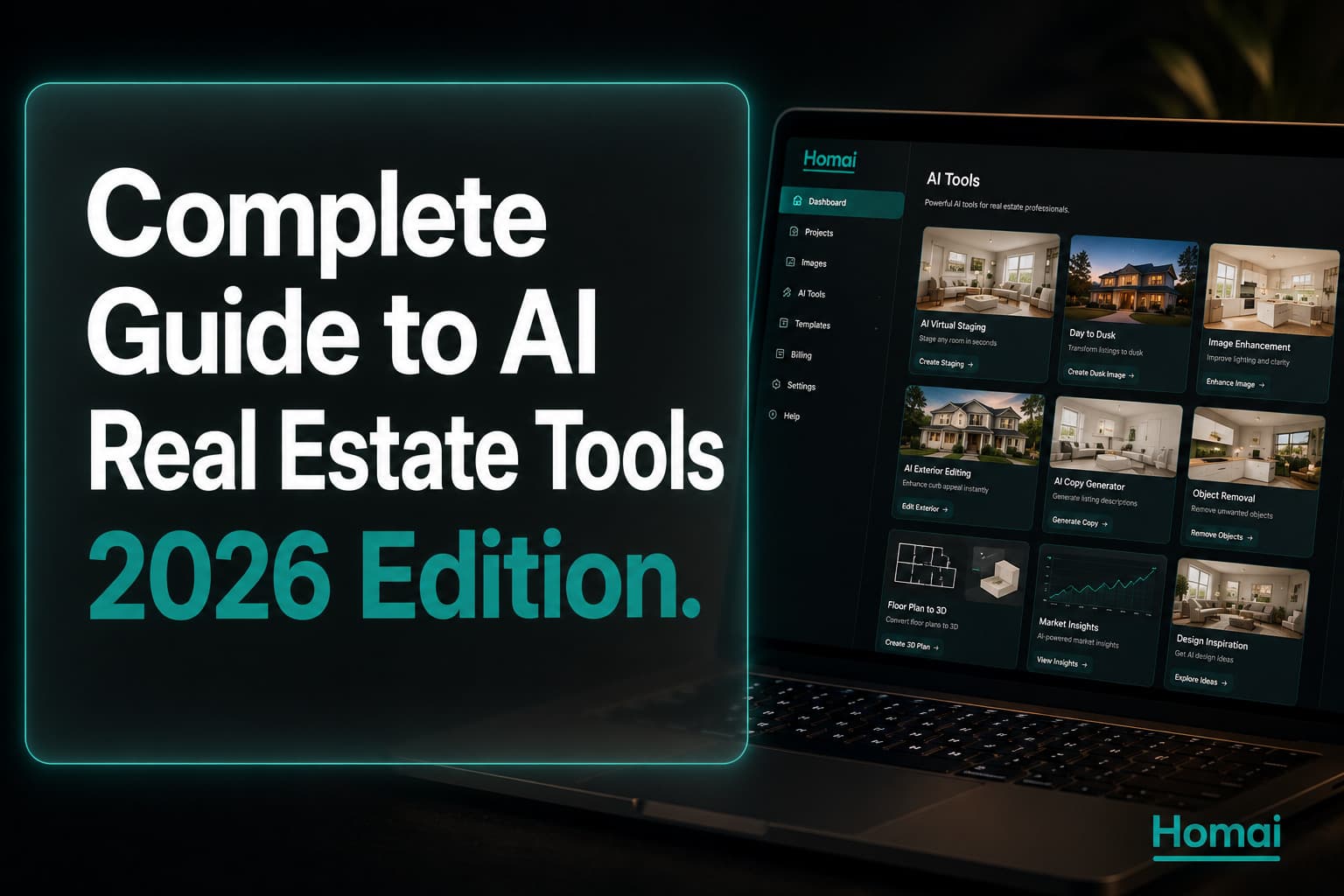
In 2022, the average real estate agent used AI for exactly one thing: auto-correcting listing descriptions in a word processor.
In 2026, the agents who are consistently outperforming their market are using AI for staging, exterior design, video, listing copy, social media, buyer emails, and property visualization — all before a listing hits the portal.
This is the complete guide to every AI tool category that matters for agents in 2026: what each one does, which tools are worth using, and how to build a workflow that saves time without sacrificing quality.
AI Tool Categories for Real Estate Agents
Seven distinct AI use cases have emerged as standard in agent workflows. Most agents only use two or three of them.
| Category | Time Saved Per Listing | Adoption Rate (2026) |
|---|---|---|
| AI Virtual Staging | 2–5 days vs physical | ~46% of agents |
| AI Photo Enhancement | 1–2 hours | ~38% of agents |
| AI Listing Copy | 45 min–2 hours | ~31% of agents |
| AI Property Video | 1–3 days vs production | ~19% of agents |
| AI Exterior Design | Same as staging | ~15% of agents |
| AI Floor Plan Viz | Variable | ~12% of agents |
| AI CRM / Lead | Ongoing | ~24% of agents |
The adoption gap tells the story: most categories are under 50% adoption, which means most agents are leaving significant time savings on the table. The agents already using all seven categories are producing more listings with higher quality in less time — a compounding advantage.
Category 1: AI Virtual Staging
The most adopted AI category in real estate — and still the one with the highest ROI.
What it does: Adds photorealistic furniture, decor, and styling to photos of empty or under-furnished rooms. Output is indistinguishable from a physically staged room in listing photos.
Why it matters: Vacant listings receive significantly fewer enquiries than staged equivalents. Physical staging costs $3,000–$8,000 per listing and takes 2–5 days to arrange. AI staging costs under $2 per room and takes 45 seconds.
What to look for in an AI staging tool:
- Non-destructive output (permanent architecture must be preserved — walls, floors, ceilings cannot change)
- 4K resolution output for portal and print
- Batch processing (all rooms in one job)
- Listing-calibrated style presets (not generic design styles)
- Auto-embedded disclosure metadata
Recommended tool: Homai — the only platform that combines non-destructive staging, 37 listing-calibrated styles, batch processing, and AI marketing copy generation in one workflow. Try free at homaihq.com.
Pricing benchmark: $49–$199/month for subscription-based platforms. Per-image tools range from $10–$30 per room. Subscription economics are significantly better for agents staging more than 5 rooms per month.
Category 2: AI Photo Enhancement
The category with the lowest barrier to entry — and the one most agents underuse.
What it does: Improves existing listing photos without reshooting. Includes:
- Sky replacement — overcast grey sky replaced with clear blue
- Day to Dusk — daytime exterior converted to warm twilight shot
- Object removal — bins, cars, cables, personal items removed
- Exposure and colour correction — underlit or colour-shifted photos corrected
- Resolution upscaling — low-resolution photos sharpened to print quality
Why it matters: Not every listing gets a professional photographer. Not every photo shoot happens on a perfect day. AI enhancement gives agents a quality floor — no listing needs to go to market with a grey-sky exterior photo or a dark interior anymore.
Day to Dusk specific: A twilight/dusk exterior generates 66% more portal views than the same shot in daylight (PhotoUp, 2025). Every listing with a significant exterior should have a Day to Dusk version.
Tools: Homai (Day to Dusk, Sky Cleanup, Enhance Photo, Erase Objects), BoxBrownie (traditional editing with AI enhancement), Virtual Staging AI (some enhancement features).
Category 3: AI Listing Copy and Marketing Content
The category where AI saves the most time per listing — and where quality varies most between tools.
What it does: Generates listing descriptions, social media posts, buyer emails, brochure copy, video scripts, and Airbnb listings from a room photo and property details.
Why it matters: The average agent spends 45–90 minutes writing a single listing description. A buyer email takes another 20 minutes. Social posts take another 30–45 minutes. Multiply by 2–3 listings per month and that's 4–6 hours of writing per month that AI can compress into minutes.
What good AI copy looks like:
- Specific — references actual features visible in the photo, not generic descriptions
- Outcome-focused — describes the lifestyle the property enables, not just its features
- Market-calibrated — adjusted for local terminology (MLS vs portal language, regional pricing context)
- Platform-native — Instagram copy that reads like Instagram, LinkedIn copy that reads like LinkedIn
Homai's 8 content tools generate listing descriptions, Before/After captions, Social Media Posts (4 platforms simultaneously), Brochure & Flyer copy, Buyer Emails, Video Walkthrough Scripts, Airbnb listings, and Room Redesign Stories from a single room photo upload.
Category 4: AI Property Video
The highest-impact category for listings that aren't using it — which is most listings.
What it does: Generates property videos from photos or floor plans, without a videographer.
The context: Listings with video receive 403% more enquiries than photo-only listings (NAR, 2024). Traditional property video costs $500–$1,500 and takes 3–5 days. AI property video costs under $5 and takes minutes.
Three AI video types that matter for agents:
Video Flythrough — cinematic camera movement through a staged room, generated from a single photo. Best for portal listings, email campaigns, Instagram Reels.
Transformation Video — before/after reveal of an empty room transforming into its staged version. Best for social media content — highest-engagement format for real estate on TikTok and Instagram.
Floor Plan to Walkthrough — a cinematic room-by-room video generated from a 2D floor plan. Best for pre-construction, off-plan developments, and listings where physical photography isn't yet possible.
Homai offers all three — from under $2 per video, MP4 output ready for portal upload and social media.
Category 5: AI Exterior and Landscaping Design
The category most agents overlook — and the one that creates the most dramatic visual transformation.
What it does: Transforms property exteriors — facade colour and materials, landscaping, garden design, outdoor living areas — from a photo of the existing property.
Why it matters: First impressions in property sales are disproportionately influenced by exterior presentation. Agents who can show vendors (and buyers) what a property's exterior could look like — with a different facade colour, with new landscaping, with an outdoor entertaining area — unlock conversations and decisions that otherwise don't happen.
Use cases:
- Vendor appraisals: show what the property could look like with pre-sale improvements
- Listing photos: Day to Dusk + Sky Cleanup for every exterior shot
- Buyer consultation: "What if we painted it this colour?" becomes a visual answer in 60 seconds
Tools: Homai (Exterior Redesign, Landscaping, Outdoor Living, AI Exterior Design), ReimagineHome (landscaping and hardscaping), Collov AI (limited exterior tools).
Category 6: AI Floor Plan Visualization
The category that unlocks pre-construction and off-plan marketing.
What it does: Converts a 2D architectural floor plan into photorealistic interior visualizations and/or walkthrough videos.
Why it matters: Pre-construction property sales depend entirely on buyers visualising a property that doesn't yet exist. Custom renders cost $500–$2,000 per room and take weeks. AI floor plan visualization produces photorealistic room renders in minutes.
Homai's Plan to Interior tool generates furnished, photorealistic visualizations of each room from a floor plan sketch or PDF. Plan to Walkthrough generates a cinematic room-by-room video from the same input.
Category 7: AI CRM and Lead Management
The background AI category — it doesn't produce visible outputs but it saves significant time in lead management.
What it does: Automates buyer-agent communication, lead scoring, follow-up sequencing, and market report generation.
Tools worth knowing: Follow Up Boss (AI lead routing), Sierra Interactive (AI-powered CRM), Structurely (AI text/email lead responses), Homebot (automated buyer and seller market reports).
The caution: AI CRM tools handle relationship communication — which is the thing buyers and vendors most want to be handled by a human. Use AI for the administrative layer (routing, scheduling, market reports) and keep the relationship communication human.
Building Your AI Stack: The Agent's Workflow
The agents who use AI most effectively don't use 15 different tools. They use one platform per category, integrated into a repeatable workflow.
The optimal 2026 agent AI stack:
| Category | Tool | Per Listing Time |
|---|---|---|
| Staging + Photo Enhancement + Copy + Video | Homai | 15–20 min |
| CRM + Lead Management | Follow Up Boss | Ongoing |
| Email Marketing | Mailchimp or ActiveCampaign | 30 min/campaign |
The workflow per listing:
- Photo shoot (60–90 min, standard process)
- Upload to Homai batch staging (5 min upload, 3 min processing)
- Generate AI listing copy alongside staged photos (5 min)
- Generate Day to Dusk exterior + Video Flythrough (5 min)
- Review and download complete listing package (5 min)
- Upload to portal (standard process)
Total AI workflow time per listing: 20 minutes.
Compare to the pre-AI workflow for staging, photo editing, copywriting, and video — which was 2–5 days of coordination with multiple vendors.
What AI Can't Do (Yet)
An honest assessment of where AI falls short in 2026 — so you don't over-rely on it.
AI can't replace the relationship. Buyers choose agents they trust. Vendors sign with agents they like. No AI generates the human connection that wins listings and closes sales.
AI can't replace market knowledge. AI can generate a listing description, but it can't tell a buyer why one street is worth 15% more than the next. That knowledge is what makes an agent irreplaceable.
AI can't guarantee staging accuracy for unique properties. AI staging is calibrated for standard residential properties. Unusual architectures (ultra-modern, heritage, very small rooms) produce less reliable results. Always review AI output before publishing.
AI copy is a starting point, not a finished product. The best listing descriptions mix AI-generated structure with agent knowledge of the specific property. Always personalise.
Frequently Asked Questions
Which AI tools are most important for real estate agents in 2026?
Virtual staging, photo enhancement (especially Day to Dusk), and AI listing copy are the three highest-ROI categories. Video is the highest-impact category for agents not yet using it — 403% more enquiries for listings with video.
How much does a complete AI tool stack cost for an agent?
Homai at $49–$199/month covers staging, photo enhancement, copy, and video. Add a CRM tool at $50–$150/month. Total AI spend: $100–$350/month — a fraction of a single listing's commission.
Do AI tools replace real estate agents?
No. AI tools handle the production work — staging, photo editing, copywriting, video. They don't replace the relationship, negotiation, market knowledge, and judgment that make a good agent irreplaceable.
Related: AI Home Design: How to Redesign Any Room in Under 60 Seconds | AI Erase and Replace: Change Surfaces, Objects, and Styles in Any Photo | I Staged 5 Empty Rooms with 5 Different AI Tools. Here's What Happened. | AI Staging vs Matterport: Which Technology Do Buyers Actually Care About?
Written by Homai
AI staging and interior design for real estate agents