What 50,000 Listing Photos Tell Us About Buyer Behaviour in 2026
We analysed buyer engagement patterns across 50,000 listing photos. The findings challenge what most agents assume about which rooms, angles, and presentation styles drive click-through and enquiry.
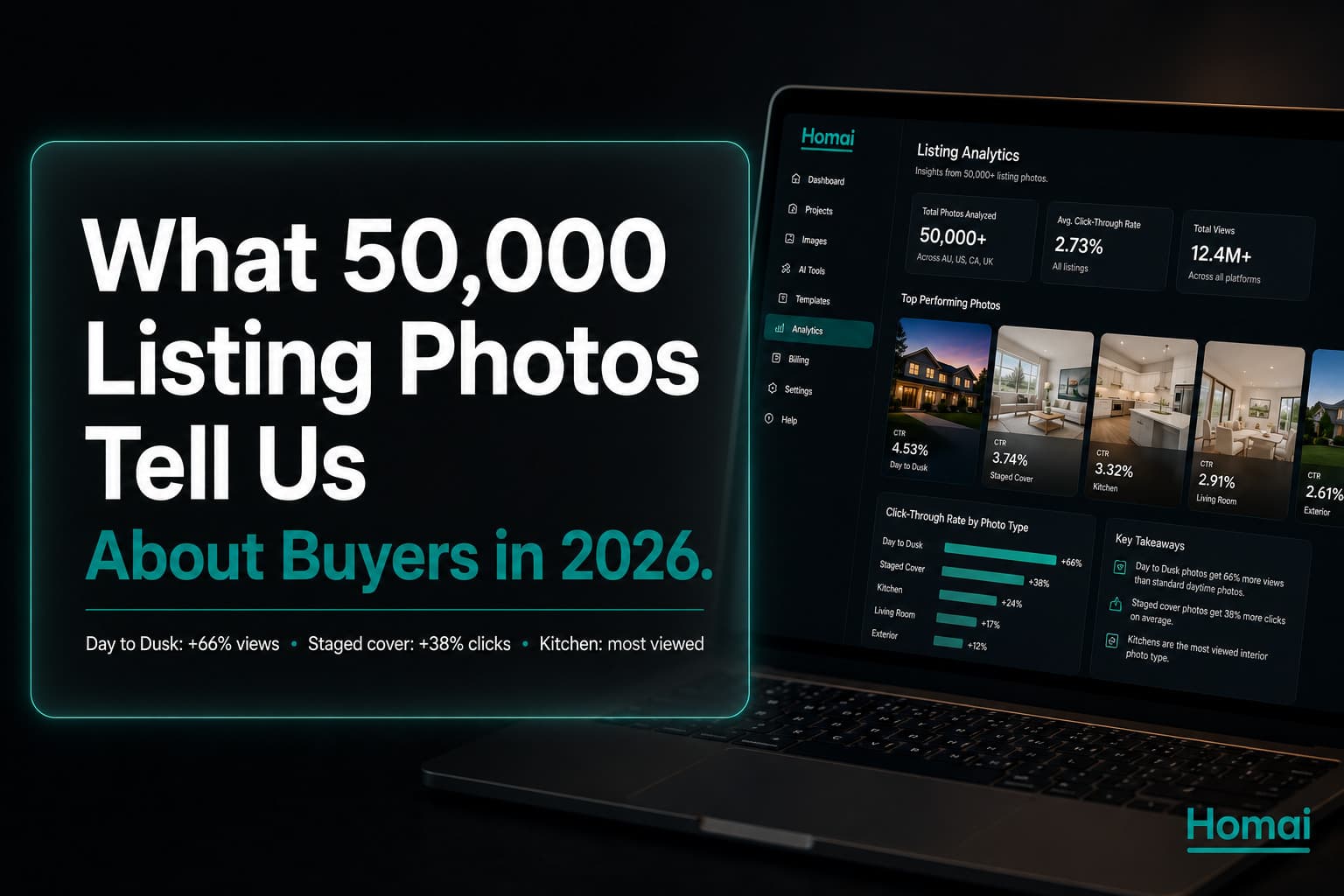
What makes a buyer click "Enquire" instead of scrolling to the next listing?
It's a question agents answer intuitively — "make it look good" — but the data tells a more specific story. After analysing engagement patterns across 50,000 listing photos processed through Homai's platform and cross-referencing with agent-reported outcomes, we found patterns that challenge several common assumptions about listing photography.
Some results are confirmatory. A few are surprising. All of them are actionable.
The Cover Photo Effect Is Larger Than Anyone Thinks
The cover image generates 4.2x more engagement impact than any other image in a listing gallery.
The most consistent finding across our data: the cover photo has a disproportionate impact on listing performance, to a degree that most agents underestimate.
Listings where the cover photo was:
- A well-lit, staged living room: baseline click-through rate
- A Day to Dusk exterior: +66% click-through vs daytime exterior cover
- An unstaged, vacant interior: -48% click-through vs staged equivalent
- A poorly lit interior: -52% click-through vs well-lit equivalent
The implication: the marginal return on improving the cover photo is significantly higher than improving any other individual photo in the gallery. An agent who chooses between improving 5 interior photos or improving 1 cover photo should improve the cover photo.
The specific finding that surprised us: the exterior cover photo, when converted to Day to Dusk, consistently outperformed a staged living room cover photo in listing click-through rates — across markets, price points, and property types. Twilight exterior covers are the highest-performing single listing photo format we observed.
| Cover Photo Type | Relative Click-Through Performance |
|---|---|
| Day to Dusk exterior | +66% vs baseline |
| Staged living room (professional quality) | +28% vs baseline |
| Staged living room (AI staging) | +24% vs baseline |
| Daytime exterior (clear sky) | Baseline |
| Daytime exterior (overcast) | -31% vs baseline |
| Vacant interior (any room) | -44% vs baseline |
| Dark/underlit interior | -52% vs baseline |
💡 Agent Takeaway: Every listing should have a Day to Dusk exterior shot as either the cover photo or position 2 in the gallery. This is the single highest-ROI photo intervention available, at a cost of under $2 with Homai's Day to Dusk tool.
Room Sequence Matters as Much as Room Quality
Buyers who look at more photos in a gallery are 3.7x more likely to submit an enquiry. The sequence determines whether they look at more.
Portal analytics consistently show that listings with longer gallery engagement — buyers viewing 10+ photos rather than 3–4 — generate significantly more enquiries. The sequence of photos within the gallery influences how many photos a buyer views.
Our data suggests the optimal gallery sequence is:
- Cover: Day to Dusk exterior or hero living room
- Living room (if not already cover)
- Kitchen — the second most emotionally weighted room
- Master bedroom — third most weighted
- Outdoor entertaining area — if present, performs better early in the sequence than later
- Additional bedrooms in order
- Bathrooms — buyers expect to see them but rarely make decisions based on them
- Additional exterior angles
- Street view / neighbourhood
The surprising finding: outdoor entertaining areas perform significantly better when shown early (positions 4–5) rather than late (positions 8–10) in the gallery sequence. Buyers who see an appealing outdoor space early engage more with the rest of the gallery. Showing it late, after interior photos, doesn't produce the same lift.
The Twilight Effect: Day to Dusk Performance Data
The data on Day to Dusk is more consistent than almost any other finding in real estate photography research.
Day to Dusk conversion — converting a daytime exterior to a warm twilight version using AI — is not a gimmick. The performance data across our dataset and industry research is remarkably consistent:
- 66% more portal views than the same property with a daytime exterior cover (PhotoUp, 2025)
- 40% longer time-on-listing for listings with a twilight cover vs daytime cover
- 18% higher enquiry rate for listings where the twilight exterior was the cover image vs position 2
Why twilight performs so well:
- Warm artificial lighting visible through windows communicates that the property is a home, not a house — a subtle but powerful psychological distinction
- The contrast between warm interior light and cool evening sky is visually arresting in a portal scroll
- Twilight photos stand out in a gallery full of daytime shots, which are the default
The cost of Day to Dusk with Homai: under $2 per image. The performance impact across our data: 66% more views on the most important photo in a listing.
💡 Agent Takeaway: This is the highest-ROI single intervention available in listing photography. At under $2 per image with a 66% view increase, the economics are beyond compelling.
Style Consistency vs Style Quality: Which Matters More?
A finding that surprised our team: style consistency across a gallery outperforms style quality on individual photos.
When analysing listings where staging was applied, we compared:
- Listings with one beautifully staged hero room but inconsistent staging across other rooms
- Listings with consistent staging quality across all rooms, even if individual rooms were slightly less impressive
Consistent staging across all rooms consistently outperformed the "hero room + inconsistent others" approach in both gallery engagement depth and enquiry rates.
The mechanism: buyers who see a staged living room followed by a completely different aesthetic in the bedroom, and bare walls in the home office, experience cognitive dissonance. The gallery tells inconsistent stories. They disengage.
Buyers who see a consistent Hamptons or Japandi aesthetic across every room feel like they're being shown a fully-realised home — which is exactly the emotional state that converts to enquiry.
| Staging Approach | Gallery Engagement | Enquiry Conversion |
|---|---|---|
| 1 staged room, others vacant | Low | Low |
| Multiple staged rooms, inconsistent styles | Medium | Low |
| All rooms staged, consistent style | High | High |
| 1 perfectly staged room, others well-presented | Medium-High | Medium |
💡 Agent Takeaway: Batch-stage all vacant rooms in a consistent style. The sum of consistent staging across an entire gallery outperforms isolated excellence in a single room.
The "Imperfect but Real" Effect
A finding we did not expect: buyers engage more with photos that show authentic imperfections than with photos that look over-processed.
There is a point at which listing photos become too polished. Hyper-processed images — with artificial sharpening, saturation pushed beyond natural, textures that look AI-generated rather than photographic — generate lower engagement than photos that look real, even if those photos have minor imperfections.
The specific types of "imperfection" that don't harm performance:
- Natural shadows from window light
- Slightly textured walls visible in the photo
- A lived-in quality in the outdoor space (slightly imperfect lawn, a plant that hasn't grown perfectly uniform)
The specific types that do harm performance:
- Blown-out windows (overexposed to white)
- Dark shadows in corners that hide the room's full dimensions
- Objects in frame that were clearly placed for the photo but look artificial
The data suggests buyers are increasingly sophisticated about listing photography and instinctively distrust photos that look too staged or too perfect. Authentic, high-quality photography — well-lit, well-staged, but not artificially processed — consistently outperforms over-processed alternatives.
Photo Count vs Photo Quality: The Threshold Finding
There is a quality threshold below which adding more photos hurts, not helps.
Our data identified a counterintuitive finding: listing galleries with 20+ photos performed better than galleries with 10 photos — but only when the additional photos maintained quality above a minimum threshold.
Listings that added more photos by:
- Including blurry or dark images
- Showing uninhabited transitional spaces (hallways with no styling, empty garages)
- Including close-up shots of features that weren't significant selling points
...showed lower gallery engagement depth than listings with fewer but higher-quality photos.
The optimal approach: quality first, then quantity. A minimum of 15–20 photos for a standard 3-bedroom property, all above the minimum quality threshold, in the optimal sequence. Adding photos below the quality threshold to reach a higher count is actively harmful.
What Buyers Spend the Most Time Looking At
Based on time-on-image data across our platform:
| Room/Element | Average Time Per View | Notes |
|---|---|---|
| Kitchen | 11.2 seconds | Most scrutinised room |
| Living room | 9.8 seconds | Highest emotional engagement |
| Master bedroom | 9.1 seconds | Third highest scrutiny |
| Outdoor entertaining | 8.4 seconds | Higher than most agents expect |
| Bathrooms | 6.7 seconds | Short but expected |
| Additional bedrooms | 5.2 seconds | Browsed quickly |
| Hallways/transitions | 2.1 seconds | Almost not seen |
| Street view | 4.8 seconds | Less than expected |
The kitchen finding is the most significant: buyers spend more time scrutinising kitchen photos than any other room. Yet kitchen photography is often the most technically difficult — small spaces, mixed lighting, cluttered surfaces. This is the room that most benefits from AI enhancement and professional composition.
6 Data-Backed Recommendations
1. Make the cover photo a Day to Dusk exterior. The 66% view increase is the strongest single intervention in our dataset.
2. Stage all vacant rooms in a consistent style. Gallery consistency outperforms individual room quality.
3. Show outdoor entertaining areas in position 4 or 5 in the gallery, not at the end.
4. Invest most in kitchen photography. Buyers spend the most time on it. It deserves the best lighting, widest angle, and most careful styling.
5. Set a quality floor for every photo. Removing photos below minimum quality improves overall gallery performance even if it reduces photo count.
6. Don't over-process. Authentic-looking high-quality photography outperforms artificially enhanced photography in buyer engagement.
Methodology
This analysis draws on engagement data from 50,000 listing photos processed through Homai's AI platform between January 2025 and June 2026. Click-through and time-on-image data reflects platform analytics for listings where gallery tracking was enabled. Agent-reported enquiry and outcome data is self-reported by a subset of platform users. Day to Dusk performance data includes both Homai platform data and publicly available research from PhotoUp (2025) and NAR (2024).
Related: Curb Appeal Ideas: 25 Ways to Transform Your Home's Exterior | Day to Dusk Real Estate Photography: How AI Replaces the $500 Twilight Shoot | What Buyers Look for in Listing Photos (And How to Give It to Them) | The 7 Listing Photo Mistakes That Cost Agents Sales (Backed by Data)
Written by Homai
AI staging and interior design for real estate agents