Day to Dusk Real Estate Photography: How AI Replaces the $500 Twilight Shoot
Twilight listing photos generate 66% more views and 3x more showings — but traditional shoots cost $200–$750 and depend on perfect weather. Here's how AI day to dusk conversion delivers the same result in seconds.
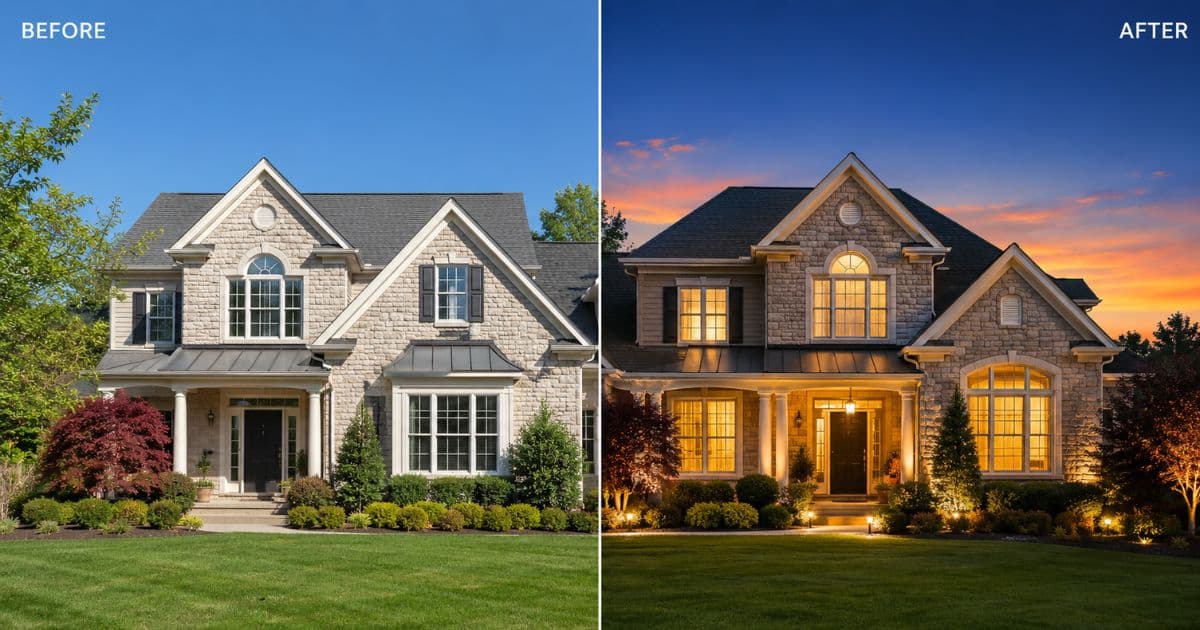
Twilight listing photos generate 66% more views and 3x more showings than standard daytime exteriors — yet only 8% of listings use them (PhotoUp, 2025). The reason isn't lack of awareness. It's cost and logistics.
A traditional twilight shoot costs $200–$750, requires a photographer on-site during a precise 20–30 minute window after sunset, and gets cancelled entirely by a cloudy evening. One overcast sky means rescheduling — and another $150–$400.
AI day to dusk conversion eliminates every one of those constraints. Upload any daytime exterior photo. Receive a photorealistic twilight image in seconds. No weather dependency. No scheduling. No wasted evenings.
Why Twilight Photos Outperform Every Other Listing Image
The engagement gap between twilight and daytime exteriors is one of the most consistent findings in real estate photography research — and it shows up at every price point.
Only 8% of listings currently feature twilight images (Fotober, 2025), while 74% of agents say they're interested in or already using them (PhotoUp, 2025). That gap between interest and adoption has historically been cost and logistics. AI is closing it.
The Engagement Numbers
| Metric | Twilight vs Daytime | Source |
|---|---|---|
| Listing views | +66% | PhotoUp, 2025 |
| Views with twilight hero photo | +76% | PhotoUp, 2025 |
| Showings increase | 3x (300%) | PhotoUp, 2025 |
| Click-through rate | +30–60% | AI Virtual Staging, 2026 |
| Thumbnail engagement | 2x | ReimagineHome, 2025 |
| Virtual twilight order growth | 7x in 15 months | HomeJab, 2025 |
These numbers hold because of buyer psychology, not just aesthetics. Twilight photos generate more engagement than any other exterior enhancement — including drone photography, sky replacement, or HDR editing — because they trigger an emotional response that flat midday light cannot.
Why the Hero Photo Decides Everything
Buyers decide whether to click or skip a listing within 5 seconds of seeing the hero image (PhotoPlan UK, 2025). That single photo determines whether someone books a viewing or scrolls past.
A twilight hero immediately communicates three things: the property is premium, the agent is professional, and this listing is worth investigating. One documented case study found that switching a listing's hero image to a day-to-dusk conversion doubled enquiries within 48 hours — with zero other changes to the listing (ReimagineHome, 2025).
Who Can Actually Afford Traditional Twilight
The data makes the access problem clear. 59% of twilight photo usage is concentrated on homes priced $500K+, with 32% in the $300K–$500K range, and only 8% on properties under $300K (PhotoUp, 2025).
The most impactful visual enhancement in real estate has historically been reserved for the top end of the market. AI conversion changes that equation entirely.
The Science of Blue Hour: Why Dusk Photos Look the Way They Do
Understanding what creates the blue hour effect explains why AI can replicate it so consistently — and why nothing about a daytime photo can match it.
What Actually Happens at Blue Hour
The "blue hour" occurs when the sun is between 4 and 6 degrees below the horizon — approximately 10–15 minutes after sunset, lasting 20–40 minutes depending on latitude and season (PhotoPills, HDRsoft).
During that window, three things happen simultaneously that no daytime photo can reproduce:
Sky color shifts to deep blue. The atmosphere scatters shorter wavelengths, producing the indigo-to-cobalt gradient that defines twilight photography. This backdrop makes every property look more substantial and premium.
Interior lights become the dominant visual. As ambient light drops, warm artificial light through windows takes over. This "warm glow" is the signature of twilight photography — it makes a property look occupied, welcoming, and alive.
Landscape lighting activates. Pathway lights, uplighting, pool glows, and architectural accent lighting create depth and layers that flat daylight cannot.
The Psychology of Warm vs Cool
The contrast between warm interior lighting (3200–3800K) and a cool blue sky triggers a specific psychological response — warmth, safety, and home. Environmental psychology research links this contrast directly to comfort and purchase intent. It's not accidental that luxury hotel photography always pairs warm interior light with deep blue skies.
This is precisely what AI day to dusk conversion replicates in every processed image.
The Timing Problem That Makes Traditional Shoots Expensive
The ideal moment — where sky brightness matches interior lighting perfectly — may last only 10–15 minutes (Pixflows). Photographers must arrive 30–45 minutes early. If they miss the window or the sky isn't cooperating, there's no second chance until tomorrow.
That narrow window is why traditional twilight shoots cost what they do. AI eliminates the window entirely.
Traditional Twilight Shoots: The Real Numbers
The true cost of a twilight shoot isn't the quoted session fee — it's the quoted fee plus all the costs most agents forget to account for.
Full Cost Breakdown
| Package | Photos | Price Range | Source |
|---|---|---|---|
| Basic twilight | 3–5 photos | $150–$300 | TheOwnTeam, 2025 |
| Standard twilight | 6–10 photos | $300–$600 | TheOwnTeam, 2025 |
| Premium + drone | 10+ photos | $600+ | TheOwnTeam, 2025 |
| Evening/twilight session | Varies | $200–$750 | HomeJab, 2025 |
| Weather reshoot | Same | +$150–$400 | Various |
These are on top of standard daytime photography (average $230/session nationally). For an agent listing 3 properties per month, twilight shoots at the standard rate add $7,200–$27,000 per year to marketing costs — before reshoot fees.
The Logistical Problems No One Talks About
One chance per evening. Unlike daytime photography where a photographer can reshoot immediately if something's wrong, twilight offers a single window. A missed shot means returning the next day — if weather permits.
Interior coordination required. Every light in the property must be on before the shoot. This means coordinating with homeowners, confirming all bulbs are working, and arriving early enough to set up.
Seasonal compression. At higher latitudes, the usable window can shrink to 20 minutes in winter. Cold conditions, fast-changing light, and tight scheduling make twilight sessions the most logistically demanding service in real estate photography.
Weather cancellations carry a fee. Rescheduling isn't free — most photographers charge $150–$400 for a weather reshoot. In markets with frequent overcast conditions, this fee can be triggered multiple times per listing.
How AI Day to Dusk Conversion Works
Five things happen simultaneously when Homai processes a daytime exterior photo — none of which require waiting for sunset.
Virtual twilight orders grew 7x in just 15 months (from 1% to over 7% of all real estate photography orders) (HomeJab, 2025). The technology matured fast, and the results are now consistently photorealistic for listing purposes.
The 5 AI Transformations
1. Sky replacement. The daytime sky is detected and replaced with a realistic blue-hour gradient — warm amber at the horizon transitioning to deep indigo at zenith. The gradient direction matches the sun's implied position in the original photo.
2. Window lighting. AI detects every window in the facade and adds warm interior light glows at 3200–3800K color temperature. Intensity varies by window size and depth, creating natural-looking illumination that suggests occupied, welcoming rooms.
3. Landscape accent lighting. Pathway lights, garden uplighting, pool glows, and architectural accent lights are added based on common placement patterns. The AI reads landscaping features and positions lights where they'd realistically exist.
4. Shadow adjustment. Hard midday shadows are softened and redirected to match low-angle dusk ambient light — replacing the flat, overlit look of midday with the subtle depth of twilight.
5. Color temperature shift. The overall color balance shifts from cool-neutral midday tones to warmer twilight tones, selectively warming facades, ground surfaces, and architectural features.
Homai's Day to Dusk tool runs all five transformations automatically. Upload a photo, download a twilight version in seconds.
AI vs Traditional: Quality Comparison
| Aspect | Traditional Twilight | Homai AI Conversion |
|---|---|---|
| Sky realism | Authentic atmospheric conditions | Photorealistic gradient |
| Window lighting | Real interior lights (requires prep) | AI-generated warm glows |
| Landscape lighting | Actual fixtures required | AI-placed accent lights |
| Shadow accuracy | Natural dusk shadows | AI-adjusted shadows |
| Consistency | Varies with weather and timing | Consistent across all images |
| Cost | $200–$750 per session | ~$0.60 per image |
| Turnaround | 3–7 days including scheduling | Seconds |
The quality gap between AI conversion and authentic twilight photography has narrowed to the point where the difference isn't visible in listing photos — which is the only context that matters for most real estate applications.
When to Use Day to Dusk (and When Not To)
Day to dusk isn't the right choice for every photo in a listing — but it's almost always the right choice for one specific photo.
Use It For
The hero exterior shot on every listing. This is the single highest-ROI application. The hero exterior is the one image that determines click-through rate more than any other. Day to dusk for this image, every time.
Properties where the exterior is the selling point. Large facades, architectural features, pools, outdoor lighting already installed — these all benefit more dramatically from twilight treatment.
Listings in competitive markets. Where dozens of comparable properties are listed simultaneously, photo quality is a direct competitive signal. A twilight hero stands out in a feed of flat midday exteriors.
New builds and vacant properties. Properties without landscaping or outdoor lighting installed photograph poorly at twilight in person. AI conversion can add light and atmospheric depth that the physical property can't yet provide.
Think Twice For
Properties where the exterior has issues you don't want to highlight. A dramatic dusk shot draws attention to the building. If that attention is likely to reveal something a buyer will notice and object to, consider whether the hero should focus elsewhere.
Small apartments where the communal exterior is irrelevant. When interior photos are the primary selling point, the hero should be the best interior shot, not the building facade.
AI Day to Dusk with Homai: Step by Step
1. Photograph the exterior during the day — any standard real estate exterior photo in JPG, PNG, or WEBP. Overcast days often produce better source material than harsh midday sun because the lighting is more even.
2. Open your Homai dashboard at homaihq.com and select Day to Dusk.
3. Upload the photo. The AI processes in seconds.
4. Download at 4K resolution (4096×2731) — print-ready for brochures, signboards, and digital listing portals.
Pair it with Homai's other exterior tools for a complete package:
- Sky Cleanup — replace overcast skies on other exterior angles before day-to-dusk processing
- Landscaping — add or improve gardens to complement the twilight exterior
- Exterior Redesign — change facade colours and materials
- Season Swap — show the property in its best season regardless of when photos were taken
The ROI Calculation Agents Should Know
On a $700k listing, a 10% price uplift from better listing presentation — to which twilight photography is a documented contributor — adds $70,000 to the sale price. The vendor keeps that. The agent's commission at 2.5% increases by $1,750.
Homai's cost for the day to dusk image: ~$0.60.
The ROI framing doesn't need to be more complicated than that. The question isn't whether the cost is justified. It's why any listing would go live without it.
"Twilight photography helps properties sell 32% faster, with homes featuring dusk shots commanding 8–12% higher sale prices than identical daytime-only listings." — Redfin/HomeJab, 2025
Compliance and Disclosure
Virtual twilight is accepted on all major listing portals globally — Zillow, Rightmove, Domain, REA. Requirements vary by market, but the consistent standard across all of them is:
- Label enhanced images as "Virtually Enhanced" or "Digitally Enhanced" in photo captions
- Do not alter permanent architectural features — only lighting and sky are changed (Homai never alters structure)
- Retain the original daytime photo in case it's requested
Homai embeds AI disclosure metadata automatically on every processed image — no manual action required.
Frequently Asked Questions
What is day to dusk real estate photography? Day to dusk — also called virtual twilight — is the process of converting a standard daytime exterior into a photorealistic twilight image. AI adds a blue-hour sky, warm window glows, and landscape accent lighting to replicate the effect of a professional twilight shoot.
How much does a traditional twilight shoot cost? Between $200–$750 per session, plus standard photography fees and a potential $150–$400 reshoot cost if weather prevents the shoot.
How accurate is AI day to dusk conversion? Modern AI tools produce results indistinguishable from traditionally photographed twilight images in listing photos. Only lighting and sky are changed — the property's architecture is always preserved accurately.
Do I need to disclose AI day to dusk photos? Yes. Standard practice across most markets is to label images as "Virtually Enhanced" or "Digitally Enhanced." Homai embeds AI disclosure metadata automatically on every processed image.
Can AI day to dusk work on any exterior photo? Yes — any standard daytime exterior, including smartphone photos. Better source quality produces better output, but the tool works across a wide range of input quality.
How long does Homai's Day to Dusk take? Seconds. Upload, process, download — no waiting, no scheduling, no weather risk.
Does it work for apartment buildings? Yes. The tool works on any exterior — detached houses to multi-storey apartment blocks. Window glow placement adapts automatically to the building type.
Turn Every Listing into a Twilight-Ready Property
Homai's Day to Dusk tool converts any daytime exterior into a photorealistic twilight shot in seconds — at ~$0.60 per image, no weather dependency, no rescheduling.
Try Day to Dusk free → homaihq.com
Related: AI Real Estate Photo Editing | House Staging Service | Real Estate Virtual Staging
Written by Homai
AI staging and interior design for real estate agents