Virtual Staging vs Interior Decorating: Which Gets More Money at Sale?
Virtual staging costs $10. Interior decorating services cost thousands. Which one actually produces a higher sale price? Data and honest analysis for agents and vendors.
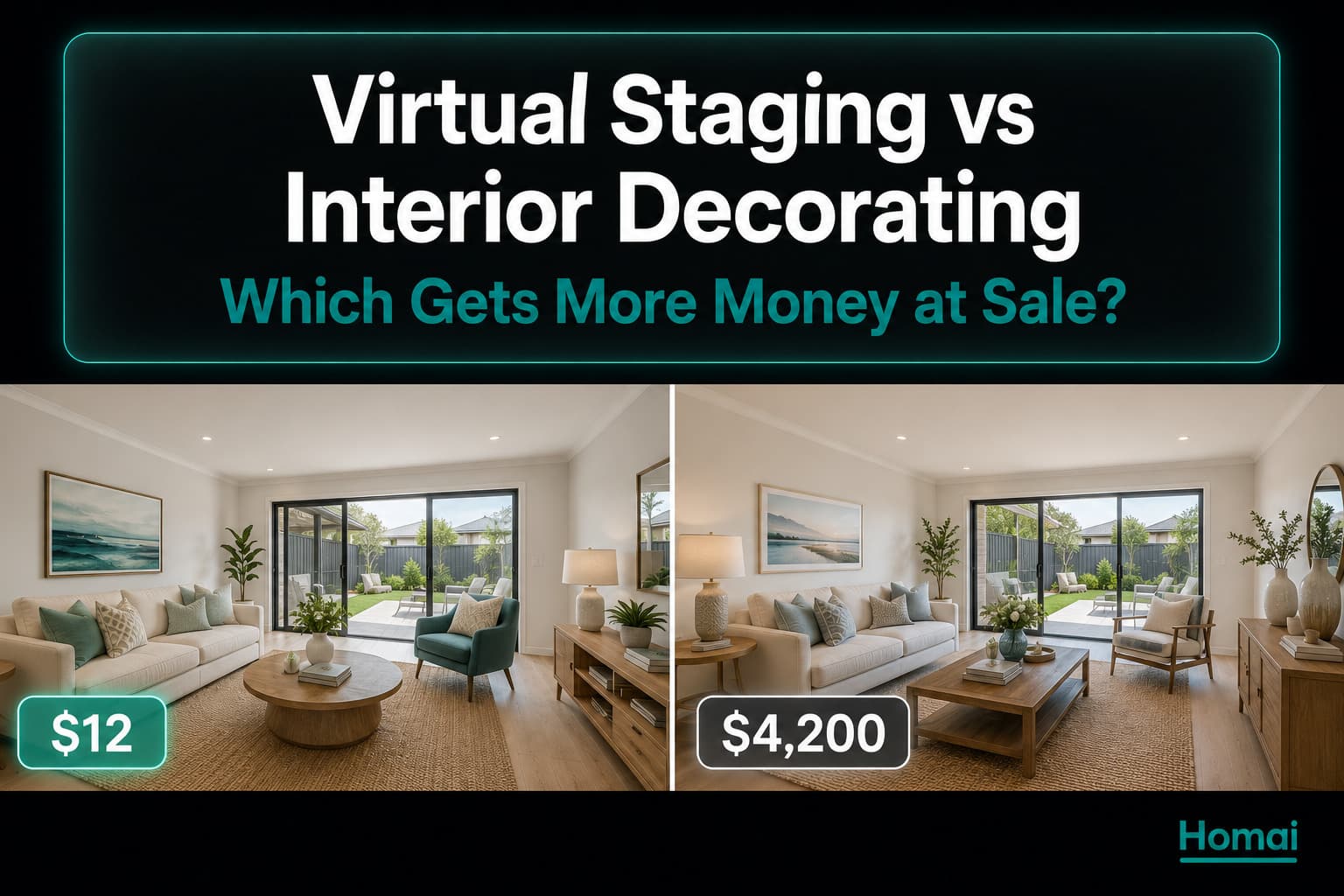
A vendor asking whether to spend $3,000 on interior decorating services or $10 on AI virtual staging is asking the right question. The wrong way to answer it is to assume the more expensive option produces proportionally better results.
The honest answer is more nuanced — and in most situations, the data favours a different conclusion than you might expect.
Defining the Two Options
These are different services solving different problems — the confusion comes from treating them as substitutes.
Virtual staging — adding photorealistic furniture to listing photos using AI. The result exists only in the photographs. The physical property remains vacant or as-is. Buyers see a staged property on the portal; they inspect an empty or unfurnished one.
Interior decorating services — a human decorator visits the property and physically improves its presentation. This ranges from rearranging existing furniture, adding accessories and soft furnishings, to a complete styling package with hired furniture and decor. Buyers see and experience the decorated property during inspections.
The critical distinction: virtual staging affects portal photos only. Interior decorating affects both photos and the physical inspection experience.
What Each One Actually Costs
| Service | Typical Cost Range | What's Included |
|---|---|---|
| AI Virtual Staging (Homai) | $10–$20 for full property | Photorealistic staged images of all vacant rooms |
| Basic Styling/Accessories | $300–$800 | Decorator adds accessories, textiles, plants to existing furniture |
| Partial Styling with Hire | $1,500–$3,500 | Some hired furniture + accessories + decorator time |
| Full Physical Staging | $3,000–$8,000+ | All furniture hired, full styling, ongoing rental for campaign period |
The cost gap between virtual staging and full physical staging is roughly 300–800x. The question is whether physical staging produces 300–800x better results. It does not.
What Each One Actually Does
The mechanism of each service determines when it adds value.
Virtual staging works by improving portal click-through rate. A staged living room photo stops a buyer scrolling at 3 seconds and makes them click through to the listing. Empty rooms don't produce that response. The value is entirely front-loaded in the digital discovery phase.
Physical staging / interior decorating works by improving the inspection experience. A buyer who walks into a beautifully styled property makes an emotional connection that's harder to achieve in an empty space. This emotional connection during inspection is what drives offers above asking price and competitive bidding.
The insight: both services improve sale outcomes, but they work at different points in the buyer journey. Virtual staging improves the online phase. Physical staging improves the offline phase. They're not substitutes — they address different parts of the process.
The Sale Price Effect: What Research Shows
NAR's research has historically measured "staging" as physical staging. The virtual staging research is newer but directionally consistent.
Physical staging (from NAR 2025 Home Staging Report):
- Staged homes sell for 1–5% more than equivalent unstaged homes
- 82% of buyers' agents say staging helps buyers visualise a property as their future home
- Staged homes sell 73% faster than unstaged equivalents
AI virtual staging (emerging research and platform data):
- Staged portal photos generate 38–46% more click-throughs than vacant room photos (Homai platform data, 2025–2026)
- Time to first enquiry is significantly reduced for listings with AI-staged photos vs vacant photos
- Sale price data is less mature than physical staging research, but directional evidence suggests similar 1–3% improvement in sale price for well-presented listings
The honest caveat: the sale price research on AI virtual staging specifically is still developing. Physical staging's 1–5% price premium is well-documented across decades of data. AI virtual staging's equivalent effect is plausible but not as thoroughly established.
The Click-Through Effect: Where the Real Difference Lives
This is where AI virtual staging has a measurable, documented advantage over no staging — and where physical staging can't help.
Portal click-through determines how many potential buyers see your property. A listing that generates 400 portal views will receive more enquiries than an identical listing with 200 views — regardless of how beautiful the physical staging is.
The click-through data (Homai platform, 2025–2026):
- Vacant room cover photo: baseline click-through
- AI-staged living room cover photo: +38% click-through vs vacant
- Day to Dusk exterior: +66% click-through vs daytime exterior
Physical staging doesn't affect click-through rate. A beautifully physically staged property still has vacant-looking photos on the portal if no one photographed it correctly or if the photos show an empty room before the staging date.
Conclusion: virtual staging directly improves the phase that determines how many buyers even discover the listing. Physical staging has no impact on this phase.
When Interior Decorating Wins
Physical styling is the better investment in three specific situations.
Luxury and prestige properties ($2M+). At premium price points, buyers expect to physically experience a beautifully styled property during inspection. The inspection experience carries more weight in the decision process than at lower price points. Physical staging's emotional impact during inspection is worth the cost.
Properties with difficult-to-visualise layouts. Some properties — unusual floor plans, split-level homes, properties with challenging room relationships — genuinely benefit from physical staging because it helps buyers understand how the space works in a way photos alone can't convey.
Markets where styling is a standard expectation. In some suburbs and price brackets, buyers arrive at inspections expecting a fully styled property. If comparable listings are all physically staged and yours isn't, the comparison at inspection is unflattering.
When Virtual Staging Wins
AI virtual staging is the better investment in these situations — which covers the majority of listings.
Vacant properties where physical staging logistics are impractical. Vendors who have already relocated, investment properties, interstate-owned properties — all benefit from AI staging because coordinating physical staging is difficult and expensive without the vendor on-site.
Properties with tight timelines. AI staging is available in 45 seconds. Physical staging requires 2–5 days lead time. For agents who need to list fast, AI staging is the only viable option.
Standard residential properties (under $1.5M) in competitive markets. The primary job is generating click-through and enquiry from the portal. AI staging achieves this at a fraction of the cost of physical staging. The marginal additional benefit of physical staging — if the vendor is comfortable with the inspection experience as-is — often doesn't justify the cost.
Properties with good existing furniture. When the property is furnished but dated or mismatched, AI staging can show a different direction without the cost of removing existing furniture and hiring replacements.
The Hybrid Approach Most Top Agents Use
The most effective listing photography strategy combines both — intelligently.
The emerging best practice among top-performing agents:
Step 1: AI virtual staging for portal photos — all vacant or under-furnished rooms staged with AI, Day to Dusk exterior, all portal images to the highest quality standard. Cost: $15–$25 for a full property.
Step 2: Light physical styling for the inspection experience — not full furniture hire, but a decorator visit to add accessories (cushions, throws, plants, artwork, table styling) that make an otherwise empty-looking inspected property feel warmer and more inviting. Cost: $300–$800.
Total cost: $315–$825 for the combined approach.
What this produces: portal photos that generate maximum click-through (AI staging) + an inspection experience that's warmer than empty (light physical styling) — at 90% less cost than full physical staging.
Frequently Asked Questions
Which produces a higher sale price — virtual staging or physical staging?
Physical staging has more established data showing 1–5% sale price improvement. AI virtual staging shows strong click-through improvement and directionally similar sale price effects but with less mature research. For most properties, the hybrid approach (AI staging for photos + light physical accessories for inspection) produces the best combination of outcomes at the lowest cost.
Is virtual staging deceiving buyers?
No — provided the "Virtually Staged" disclosure is included in listing photos and the listing description. Buyers understand virtual staging when it's disclosed and appreciate the visual context it provides. The physical inspection experience is part of evaluating whether the property suits them.
Can I use both virtual staging and physical staging on the same listing?
Yes — this is the hybrid approach that many top agents use. AI staging for portal photos (cost ~$15), physical styling/accessories for inspection (cost $300–$800). The combined approach is significantly cheaper than full physical staging while covering both the digital and physical inspection experience.
Related: Does Home Staging Really Work? The Data Every Agent Needs | How Much Does Home Staging Cost in 2026? (And the 97% Cheaper Alternative) | How Long Does It Take to Sell a Staged Home vs Unstaged? (2026 Data) | The ROI of Virtual Staging: What 1,200 Real Estate Agents Reported
Written by Homai
AI staging and interior design for real estate agents