Does Home Staging Really Work? The Data Every Agent Needs
73% faster sales. 10% higher prices. 82% of buyer's agents say staging helps. Here's the complete data on whether home staging works — and what the research says about AI vs physical staging outcomes.
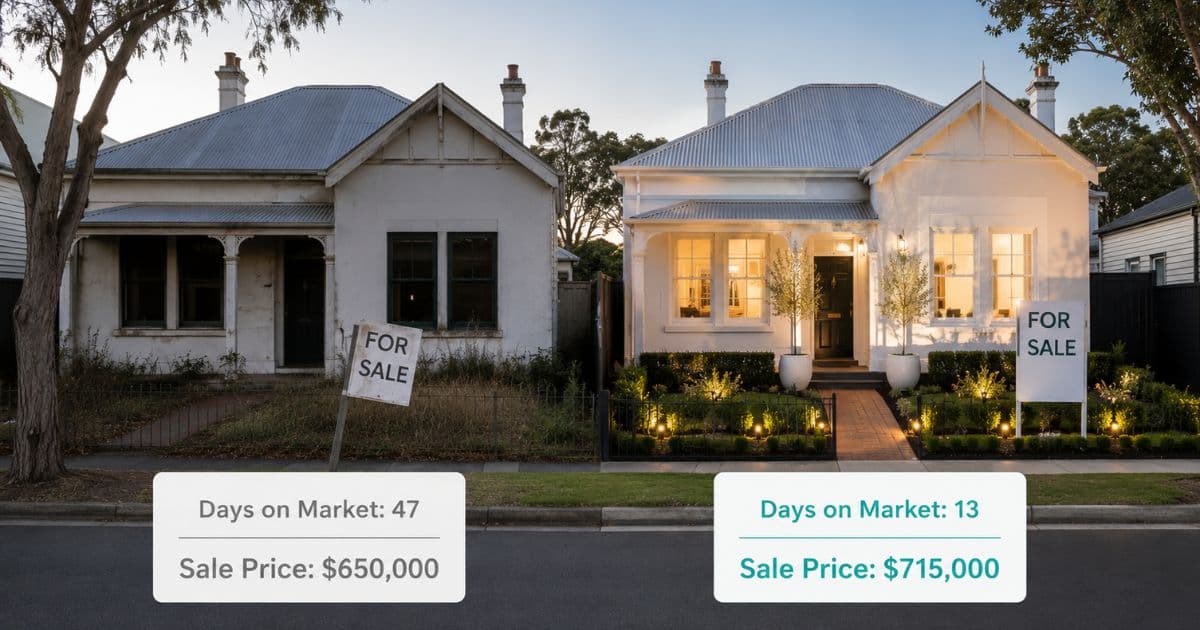
Yes. And the data is not ambiguous.
Staged listings sell 73% faster and for up to 10% more than unstaged equivalents (NAR, 2024). 82% of buyers' agents say staging makes it easier for buyers to visualise the property as their home. The median staging investment returns 586%.
The more interesting question — and the one most agents actually need answered — is whether AI virtual staging produces comparable outcomes to physical staging. The answer, for listing photography purposes, is also yes.
This guide presents the complete staging research, separates fact from industry marketing, and explains what the data actually means for listing decisions.
The Core Staging Statistics
The research on staging outcomes is remarkably consistent across studies, markets, and time periods.
| Metric | Data | Source |
|---|---|---|
| Days on market reduction | 73% fewer days for staged listings | NAR, 2024 |
| Sale price uplift | Up to 10% higher for staged | NAR, 2024 |
| Buyer agent perception | 82% say staging helps buyers visualise | NAR, 2024 |
| Median staging ROI | 586% return on staging investment | NAR, 2024 |
| Buyers citing photos as most important | 87% of all buyers | NAR, 2024 |
| Agents using AI visuals | 46% of Realtors | NAR, 2026 |
What 73% Fewer Days on Market Means Practically
If the average listing in your market sits for 45 days, a staged listing of equivalent quality sells in approximately 12 days. That's 33 fewer days of:
- Ongoing mortgage payments (for the vendor)
- Ongoing marketing costs
- Risk of price reduction after market exposure
- Opportunity cost of capital tied up in the property
For the vendor, faster sale means lower holding costs and more certainty. For the agent, faster sale means faster commission, lower campaign costs, and a vendor who refers them.
What 10% Higher Price Means Practically
On a $600k property: +$60,000 to the sale price. On a $700k property: +$70,000 to the sale price. On a $1M property: +$100,000 to the sale price.
Physical staging costs $3,000–$8,000 per property. The staging cost is typically less than 10% of the price uplift it generates. The vendor's net return from staging is overwhelmingly positive in almost every scenario.
Why Staging Works: The Buyer Psychology
The mechanism behind the statistics isn't mysterious — it's well-understood buyer psychology.
The Visualisation Problem
Most buyers cannot reliably visualise a furnished room from an empty one. This isn't a failure of imagination — it's a cognitive limitation. To mentally furnish an empty space, a buyer must simultaneously: estimate room dimensions, scale furniture to those dimensions, assess traffic flow, imagine lighting, and picture themselves living there. Most people's spatial reasoning isn't strong enough to do all of this reliably from a photograph.
Staging does this work for them. It demonstrates the room's function, establishes scale, creates warmth, and gives buyers the emotional anchor they need to picture their life there.
The First Impression Effect
87% of buyers say listing photos are the most important feature of a property listing (NAR, 2024). Buyers decide whether to click through — or skip — within 5 seconds of seeing a listing's hero image.
A staged living room creates an immediate emotional response. An empty living room creates no emotional response, or a negative one (too much work to imagine, too clinical, too risky).
The Aspiration Signal
A beautifully staged property doesn't just show buyers what a room looks like. It signals that the property is a premium asset — one worth maintaining, one that attracts quality buyers, one that commands a premium price.
Unstaged properties inadvertently signal the opposite: that the seller isn't invested in presenting the property well, which raises questions about whether they've maintained it well.
Does AI Virtual Staging Work as Well as Physical Staging?
For listing photography — the primary driver of buyer decisions — the outcomes are comparable.
This is the question most agents ask, and the answer requires distinguishing between two different contexts:
For Online Listing Photography (Where 87% of Buyer Decisions Happen)
Yes — AI virtual staging produces comparable listing performance to physical staging.
Buyers browsing portals cannot distinguish between AI-staged and physically staged rooms at standard listing photo viewing sizes. The quality of AI staging from tools like Homai is photorealistic. The emotional response buyers have to a well-executed AI-staged room is the same as their response to a physically staged room.
The evidence: staged listings — whether physically or virtually staged — consistently outperform unstaged equivalents on the metrics that matter: views, click-through rate, enquiries, and days on market.
For In-Person Open Inspections
Physical staging has an advantage when buyers physically walk through the property.
A virtually staged photo shows a furnished room. The physical property is empty. A buyer at the inspection can see the empty room — which may partially diminish the emotional impact created by the staging photography.
The practical implication: for listings in markets with high foot-traffic open inspections, combining AI staging for listing photos (for the online discovery phase) with selective physical staging for inspection days (hero rooms only) produces the best overall outcome. For most listings in online-first markets, AI staging for listing photos alone is sufficient.
The ROI Calculation by Staging Method
| Staging Method | Cost | Days on Market | Price Uplift | Net Agent Benefit |
|---|---|---|---|---|
| No staging | $0 | Baseline | Baseline | Baseline |
| AI virtual staging (Homai) | ~$3 | -73% | Up to +10% | +$1,750+ commission uplift |
| Physical staging | $3,000–$8,000 | -73% | Up to +10% | -$6,250 to +$1,750 |
The data shows comparable performance outcomes between AI and physical staging for listing photography. The cost difference is 97%. For agents, this means AI staging almost always delivers better net ROI than physical staging — producing similar listing performance at negligible cost.
What the Research Doesn't Say
Some staging claims are genuine research. Others are industry marketing.
Genuine findings:
- 73% fewer days on market for staged listings (NAR, 2024)
- Up to 10% higher sale price for staged listings (NAR, 2024)
- 82% of buyers' agents say staging helps buyers visualise (NAR, 2024)
Claims to evaluate critically:
- "Staging returns 300% on investment" — true when staging costs are correctly accounted for, but the return accrues primarily to the vendor, not the agent paying for it
- Specific price uplift percentages vary significantly by market, property type, and staging quality
- The comparison between "staged" and "unstaged" in most research includes all quality levels — a badly staged property may underperform a well-presented unstaged one
The honest summary: staging consistently improves listing performance. The magnitude of improvement depends on staging quality, market conditions, and whether the photography effectively captures the staging.
Frequently Asked Questions
Does staging work in all markets?
The data is consistent across markets, though the magnitude of the effect varies. In high-competition markets with many comparable listings, staging has the highest impact because it differentiates the listing. In low-inventory markets, staging still reduces days on market and can support price achievement.
Does staging work for investment properties?
Yes — investment properties benefit significantly from staging because they're typically vacant and buyers have no visual context for how the space functions. Virtual staging is particularly practical for investment properties because physical staging isn't cost-effective relative to the commission.
Does staging work for luxury properties?
Yes — luxury staging has the highest absolute price impact because the percentage uplift applies to a higher base price. Premium staging quality is important at the luxury end. Homai's Luxury and Art Deco presets are calibrated for premium listing presentation.
How do I know if my listing photos are good enough?
Compare view-to-enquiry conversion rate with market benchmarks. High views with low enquiries suggests the price is the barrier. Low views suggest the listing presentation (photos, description, hero image) is filtering buyers out before they even read the listing.
Does AI virtual staging require disclosure?
Yes — virtually staged images should be labelled "Virtually Staged" in photo captions. Homai auto-embeds AI disclosure metadata on every staged image.
The Data Is Clear. The Question Is Just Which Staging Method.
Staged listings sell faster and for more — consistently, across markets, across property types. The only remaining decision is whether physical staging at $3,000–$8,000 or AI virtual staging at $0.60 per image makes more financial sense for your listing volume.
Try Homai virtual staging free → homaihq.com
Related: Home Staging Cost | House Staging Service | Virtual Staging AI
Written by Homai
AI staging and interior design for real estate agents