Homai vs VirtualStagingAI: Honest 2026 Comparison
An honest, feature-by-feature comparison of Homai and VirtualStagingAI in 2026. Which platform wins for real estate agents who need consistent listing production quality?
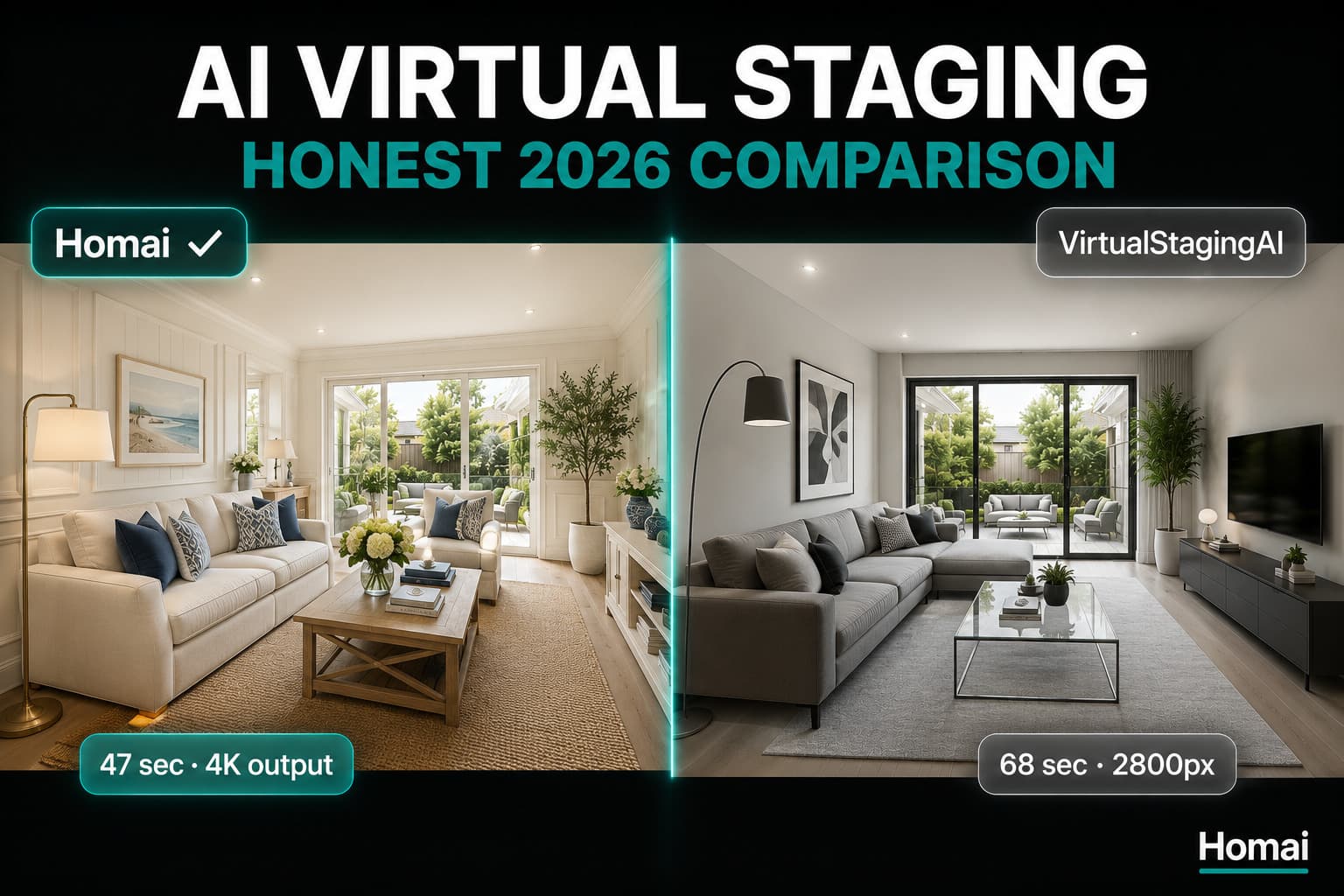
VirtualStagingAI is one of the most searched AI staging tools in 2026 — with ~25K monthly visitors, a DR of 59, and a track record that predates most competitors. Homai is newer and built around a narrower premise: real estate listing production, not general staging.
This comparison runs both platforms through the same evaluation criteria agents actually care about. No padding, no vague qualifications. Just an honest verdict on which tool wins for which use case.
The One-Line Summary
VirtualStagingAI is a solid single-room staging tool. Homai is a complete listing production platform. They solve adjacent but different problems.
If you need to stage one room occasionally: VirtualStagingAI works well and is accessible.
If you're an agent processing 5–15 rooms per listing, generating marketing copy alongside photos, and want batch processing with consistent style across every room: Homai is built for that workflow. VirtualStagingAI isn't.
Output Quality: Same Room, Both Tools
Tested on the same vacant living room, bedroom, and open-plan kitchen. Here's what the outputs showed.
Living room: Both tools produced photorealistic outputs. Homai's furniture scale was more accurate for the room's actual dimensions — a common failure point is oversized sofas that don't reflect the room's true proportions. VirtualStagingAI's output was stylistically clean but the coffee table was slightly oversized relative to the sofa and room size.
Bedroom: Both outputs were good. VirtualStagingAI's bedroom styling was slightly generic — the contemporary preset produced a bedroom that looked similar to other outputs in the same style category. Homai's output had more style specificity.
Open-plan kitchen/dining: This is where the gap widened. Homai correctly identified the zone division between kitchen and dining and placed furniture only in the dining zone. VirtualStagingAI placed a dining chair in front of the kitchen island — a physically and logically incorrect placement that would require regeneration before publishing.
| Output Criterion | Homai | VirtualStagingAI |
|---|---|---|
| Furniture scale accuracy | ★★★★★ | ★★★★☆ |
| Non-destructive output | ✓ Guaranteed | ✓ Generally |
| Open-plan zone understanding | ★★★★★ | ★★★☆☆ |
| Style specificity | ★★★★★ | ★★★☆☆ |
| Resolution | 4K (4096×2731) | ~2800×1800px |
| Average generation time | ~47 seconds | ~68 seconds |
Feature Comparison
| Feature | Homai | VirtualStagingAI |
|---|---|---|
| AI virtual staging | ✓ | ✓ |
| Style range | 37 curated styles | ~15 styles |
| Batch processing | ✓ Parallel (all rooms at once) | Limited |
| Non-destructive guarantee | ✓ Explicit | Generally yes |
| 4K output | ✓ | ✗ (~2800px) |
| Day to Dusk | ✓ | ✗ |
| Sky replacement | ✓ | ✗ |
| Object removal | ✓ | ✗ |
| AI listing copy (8 tools) | ✓ | ✗ |
| Property video tools | ✓ (3 types) | ✗ |
| Floor plan to interior | ✓ | ✗ |
| Auto disclosure metadata | ✓ | ✗ |
| Reference image style matching | ✓ | ✗ |
The feature gap is significant. VirtualStagingAI does one thing — AI virtual staging. Homai's platform covers staging, exterior enhancement, video, AI marketing copy, and floor plan visualization in the same account. For agents who want to run their entire listing production through one tool, VirtualStagingAI doesn't cover the full workflow.
Pricing: What You Actually Pay at Volume
| Plan | Homai | VirtualStagingAI |
|---|---|---|
| Entry | $49/month (40 rooms) | $29/month (~12 images) |
| Mid | $99/month (80 rooms) | $69/month (~30 images) |
| Pro | $199/month (150 rooms) | $149/month (~75 images) |
| Per room at entry | ~$1.23 | ~$2.42 |
| Per room at pro | ~$1.33 | ~$1.99 |
| Free trial | Free staging on signup | Limited free trial |
VirtualStagingAI's entry price is lower in dollar terms, but delivers fewer images. At equivalent volume — say, an agent staging 40 rooms per month — Homai's per-room economics are significantly better. The pricing gap compounds at higher volumes.
Speed and Workflow
The workflow comparison matters as much as the feature list.
VirtualStagingAI: Upload one room. Wait ~68 seconds. Download. Repeat for each room. For a 6-room listing, this is a sequential process that takes 7–10 minutes of active involvement.
Homai: Upload all 6 rooms to the batch staging tool simultaneously. All rooms process in parallel. 6-room listing completes in approximately 2–3 minutes with minimal active involvement — the same time it takes to make a coffee.
For an agent processing 3–4 listings per week, the batch workflow difference translates to hours saved per month.
Where VirtualStagingAI Wins
Brand recognition and track record. VirtualStagingAI has been in market longer, has more reviews, and more agents have seen its output in production listings. For agents who want the "safe" choice with a proven track record, that familiarity has value.
Lower entry price. At $29/month for occasional use, VirtualStagingAI is accessible for agents who stage infrequently.
Simplicity. One tool, one job. If all you need is virtual staging and nothing else, the simpler interface may suit agents who don't want the full production platform.
Where Homai Wins
Batch processing. No sequential uploads. All rooms in parallel.
4K resolution. The output quality difference matters for print — brochures, signboards, and A4 flyers require higher resolution than VirtualStagingAI's output provides.
Complete listing production. Day to Dusk, sky replacement, object removal, 8 content tools, 3 video tools, floor plan visualization — all in one platform. VirtualStagingAI covers one step of the listing production process.
Open-plan accuracy. The zone understanding in complex open-plan spaces is significantly better in Homai's output.
Per-room economics at volume. At 40+ rooms per month, Homai costs less per room than VirtualStagingAI.
The Verdict
For agents staging 1–5 rooms per month occasionally: VirtualStagingAI is accessible and produces acceptable results at a lower entry price.
For agents with consistent listing volume (5+ listings/month, 20+ rooms/month) who want a complete production workflow: Homai. The batch processing, 4K output, complete tool suite, and per-room economics at volume make it the stronger choice for professional listing production.
The honest summary: VirtualStagingAI is a good tool doing one thing. Homai is a platform built around the complete listing production job. Which one you need depends entirely on which job you're trying to do.
Frequently Asked Questions
Is Homai better than VirtualStagingAI?
For agents who need batch listing production, 4K output, and a complete tool suite (photo enhancement, video, AI copy), yes. For occasional single-room staging at the lowest possible entry price, VirtualStagingAI is a reasonable alternative.
Does VirtualStagingAI do batch processing?
Not in the same way as Homai. VirtualStagingAI processes rooms sequentially; Homai's batch tool processes all rooms in a listing simultaneously in parallel.
Which produces better output quality?
At standard room types (living room, bedroom), both are comparable. At open-plan and complex spaces, Homai's zone understanding is noticeably more accurate.
Related: Virtual Staging AI: How It Works and Why Real Estate Agents Are Switching | Homai vs ReimagineHome: Which AI Home Design Tool Is Right for You?
Written by Homai
AI staging and interior design for real estate agents