Bathroom Design Ideas: How to Plan a Renovation Before You Commit
The bathroom is the most expensive room to change your mind in. Here are the best bathroom design ideas for 2026 — and how to visualize tile, vanity, and fixture choices on your actual bathroom before spending anything.
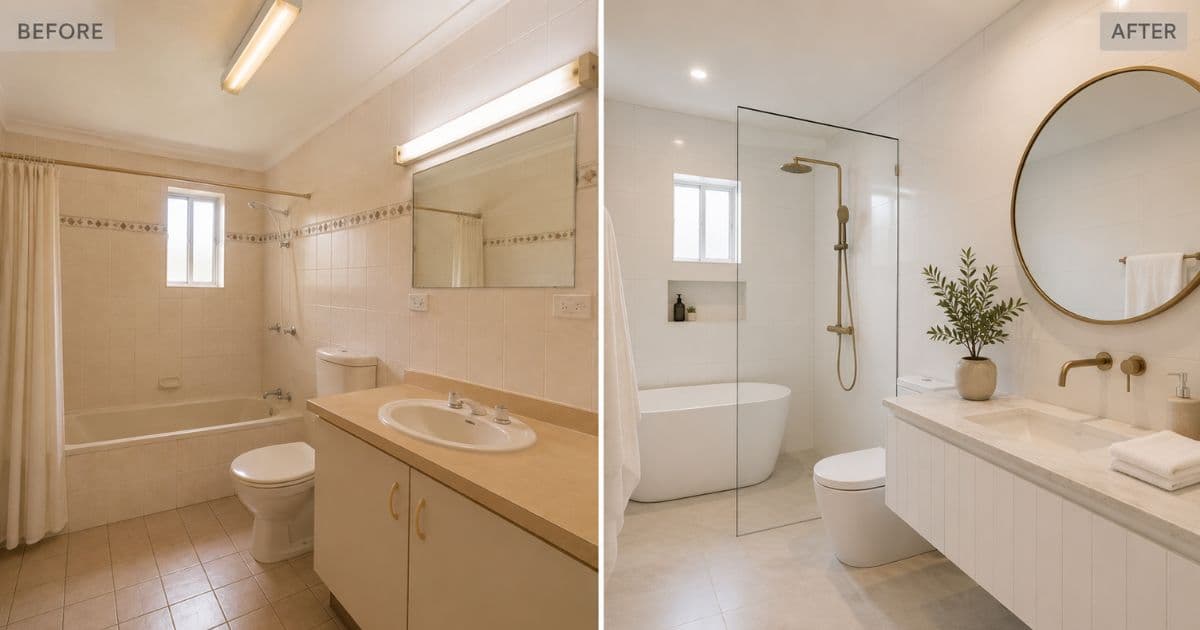
The bathroom is the most expensive room to change your mind in. Tile is set. Plumbing is in the wall. The vanity is installed. Changing any of it after the fact costs demolition plus the full cost of the replacement — typically $5,000–$15,000 for a mid-range bathroom renovation redone.
This makes the visualization decision in bathroom design particularly important. Every material and fixture choice should be confirmed on your actual bathroom before committing — not from a showroom sample, not from a mood board, and certainly not from imagination.
Why Bathroom Design Is Different from Other Rooms
Three constraints that make bathroom design decisions harder than any other room.
Materials Are Permanent
In a living room, you can swap a sofa. In a bedroom, you can change the bedding. In a bathroom, the tile is the floor. The tile is the wall. The benchtop is the benchtop. These are fixed for the life of the renovation — typically 10–20 years.
Getting a tile choice wrong costs $3,000–$8,000 to fix. Getting a vanity color wrong costs $1,500–$4,000 to fix. Getting the fixture finish wrong — chrome vs brushed nickel vs matte black — costs $800–$2,000.
The Showroom Effect
Bathroom tiles and fixtures are always evaluated in showroom lighting — typically bright, even, often warm white fluorescent. Your bathroom has different light. The tile that looked rich and textural in the showroom can look flat and dull in a north-facing bathroom with cool indirect light.
Everything Must Work Together
Tile, grout color, vanity, benchtop, mirror, fixtures, accessories, lighting — these elements interact in a bathroom more than in any other room. A tile that works beautifully with one vanity color is wrong with another. A fixture finish that looks great against white tile clashes against grey tile.
Evaluating each element independently — as a showroom sample — without seeing them together in your actual bathroom produces combination errors that are expensive to fix.
The Best Bathroom Design Directions for 2025
Four distinct aesthetic directions that consistently perform well in both residential design and real estate.
1. Japandi / Natural Stone
The dominant bathroom direction in 2025. Large-format stone-look or natural stone tile, timber vanity, matte black or brushed brass fixtures, warm indirect lighting, one plant if natural light allows.
| Element | Japandi Bathroom |
|---|---|
| Floor tile | Large format natural stone, travertine, or stone-look porcelain |
| Wall tile | Same tile as floor, or textured plaster/lime wash finish |
| Grout | Matching grout (beige or grey) — grout lines disappear |
| Vanity | Freestanding or wall-hung in natural timber or warm white |
| Benchtop | Stone — marble, travertine, or engineered stone in warm tones |
| Fixtures | Matte black or brushed brass |
| Mirror | Simple frameless or thin brass frame |
| Lighting | Warm LED strips beside or above mirror — never single overhead |
2. Modern Minimal
Crisp, clean, architectural. Large-format white or light grey tile, wall-hung vanity, chrome or matte black fixtures, frameless shower screen, hidden storage.
Who it's for: Contemporary homes, apartments, buyers or owners who want timeless functionality without a strong design statement.
The risk: clinical if the lighting and materials aren't carefully executed. Avoid pure white grout on white tiles — it reads as cold. Try warm white tile with warm grey grout instead.
3. Hamptons / Classic
White subway tile, white or navy painted vanity, brushed nickel or chrome fixtures, marble or stone benchtop, framed mirror. Relaxed elegance with wide appeal.
Best for: Family homes, real estate staging with broad demographic appeal, traditional architectural contexts.
The key detail: the hardware finish. Brushed nickel reads as more premium than chrome. Brushed brass is more Hamptons-specific. Choose one finish and use it consistently across all fixtures, taps, accessories, and mirror frame.
4. Warm Industrial
Concrete-look or dark tile, matte black fixtures, exposed pipe details where possible, dark timber accents, pendant lighting over mirrors.
Who it's for: Inner-city apartments, loft-style properties, design-forward owners.
The risk: can feel heavy in small bathrooms. Works best in larger bathrooms with strong natural light.
The Most Important Bathroom Design Decisions
1. Tile Size
The rule: larger format tiles make bathrooms feel bigger. This is one of the most reliable and consistent findings in bathroom design research.
600x600mm or larger (1200x600mm is current standard) in smaller bathrooms — the fewer grout lines, the larger the space feels. Small mosaic tiles add visual interest but make a room feel smaller.
Caveat: very large format tiles (1200x1200mm) require a perfectly level floor and a skilled tiler. They're beautiful but not forgiving of imperfect surfaces.
2. Grout Color
Grout color changes the entire character of a tiled surface. White grout between white tiles shows every water mark and stains within months. Matching or slightly contrasting grey grout is more practical and produces a cleaner, more premium look.
The direction in 2025: matching grout that disappears into the tile. Dark grout between white tiles (a previous trend) is waning. The goal is a seamless-looking surface.
3. Fixture Finish
The rule: choose one finish and use it everywhere. All taps, shower fittings, towel rails, toilet roll holder, mirror frame, and accessories in the same finish. Mixing chrome and matte black and brushed brass looks incoherent.
The dominant finish in 2025: matte black (highest contrast, contemporary) and brushed brass (warmer, more luxurious). Brushed nickel remains a safe classic.
4. Vanity Height and Type
- Wall-hung vanity: makes the bathroom feel larger (floor visible underneath), easier to clean, and more contemporary. Typically 850–900mm from floor to benchtop (standard ergonomic height).
- Freestanding vanity: classic, warmer aesthetic, typically timber-based. Can feel more grounded and residential.
- Built-in with mirror cabinet: maximises storage in small bathrooms.
How to Visualize Bathroom Design Decisions with Homai
Every material and fixture combination, tested on your actual bathroom photo before committing.
Change Surface Color — repaint any tile, wall, vanity, or surface in any color. Test dark tiles vs light tiles, navy vanity vs white vanity, different benchtop materials.
Renovation Preview — see the complete renovated bathroom before any work begins. Full tile change, new vanity, new fixtures — all applied to your actual bathroom photo.
Interior Redesign — transform your current bathroom into any design direction to understand how different aesthetics translate to your specific bathroom's proportions.
The sequence for a bathroom renovation decision:
- Use Interior Redesign to explore direction (Japandi, Hamptons, Modern)
- Use Change Surface Color to test specific tile and vanity colors
- Use Renovation Preview to see the complete combination
- Commit with visual confirmation from your actual bathroom
Bathroom Design for Real Estate
Bathrooms significantly influence buyer perception — and are one of the cheapest rooms to cosmetically improve.
Pre-Sale Cosmetic Improvements
A full bathroom renovation costs $10,000–$30,000 and takes 2–4 weeks. But cosmetic improvements that cost $500–$2,000 can shift buyer perception significantly:
- Re-grout: old grout that has yellowed or stained is one of the strongest negative signals in a bathroom. Re-grouting costs $300–$800 and transforms the appearance.
- Repaint the vanity: a dated timber or pine vanity repainted in a dark grey or warm white looks contemporary. Cost: $200–$400.
- Replace fixtures: swapping chrome fixtures for matte black or brushed brass costs $300–$600 and dramatically updates the bathroom's appearance.
- Replace the mirror: a frameless or thin-framed mirror replaces a dated framed mirror for $150–$400.
Use Homai's Change Surface Color to visualize these changes on your actual bathroom before the vendor authorises the spend.
Frequently Asked Questions
What bathroom tile is most popular in 2025?
Large-format natural stone look or concrete look porcelain in warm neutral tones (travertine, sand, warm grey). The format is 600x600mm or larger. Matching grout color.
What fixture finish should I choose?
Matte black or brushed brass are the dominant premium choices in 2025. Brushed nickel is a safe classic. Choose one finish and use it consistently throughout the bathroom.
How do I make a small bathroom feel larger?
Large-format tiles, matching grout, wall-hung vanity (floor visible), frameless shower screen, good lighting, limited accessories on surfaces.
Can home AI help me plan a bathroom renovation?
Home AI — like Homai — shows your bathroom after a renovation in photorealistic detail before any work begins. Test tile choices, vanity styles, and fixture finishes on a photo of your actual bathroom. This is home AI applied to one of the most expensive and least reversible renovation decisions homeowners face.
Can I see what my bathroom will look like after renovation before committing?
Yes — Homai's Renovation Preview and Change Surface Color tools visualize tile, vanity, and fixture changes on your actual bathroom photo before any work begins.
What makes a bathroom staging-ready for real estate?
Spotlessly clean surfaces (no soap scum, no mould, no staining), matching white towels folded spa-style, spa-quality soap and accessories, a single plant if natural light allows, all personal products completely removed.
See Your Bathroom Renovated — Before You Commit
Test tile colors, vanity options, and fixture finishes on your actual bathroom photo. Free to start at homaihq.com.
Try bathroom renovation visualization → homaihq.com
Related: How to Visualize a Home Renovation | House Design Interior Design | Paint Color Ideas
Written by Homai
AI staging and interior design for real estate agents