AI in Real Estate 2026: The Statistics Every Agent Needs to Know
A research-backed roundup of every significant AI adoption statistic in real estate for 2026. Click-through rates, staging ROI, listing performance data, and adoption figures — all in one place.
Numbers don't make decisions. But they make conversations easier. Whether you're trying to convince a vendor that virtual staging is worth it, justify an AI tool subscription to your principal, or understand where the market is heading — the right statistic at the right moment is worth a lot.
This is the most thorough roundup of AI adoption and performance statistics in real estate for 2026. We've pulled from NAR research, industry reports, our own platform data, and publicly available studies — and cited every source.
Bookmark it. Share it with vendors. Use it in appraisals.
Listing Photography Performance Data
Professional listing photos generate 61% more views than non-professional photos. Source: Redfin, 2024
Properties with professional photography sell for $3,400–$11,200 more than comparable listings without. Source: Redfin, 2024
Day to Dusk (twilight) exterior photos generate 66% more portal views than equivalent daytime exterior shots. Source: PhotoUp, 2025
Listings with 20+ photos receive 3x more enquiries than listings with 5–9 photos. Source: Zillow, 2024
Buyers spend an average of 11.2 seconds looking at kitchen photos — more than any other room in a listing gallery. Source: Homai platform data, 2025–2026
The cover/hero photo generates 4.2x more engagement impact than any other image in a listing gallery. Source: Homai platform data, 2025–2026
Virtual Staging Statistics
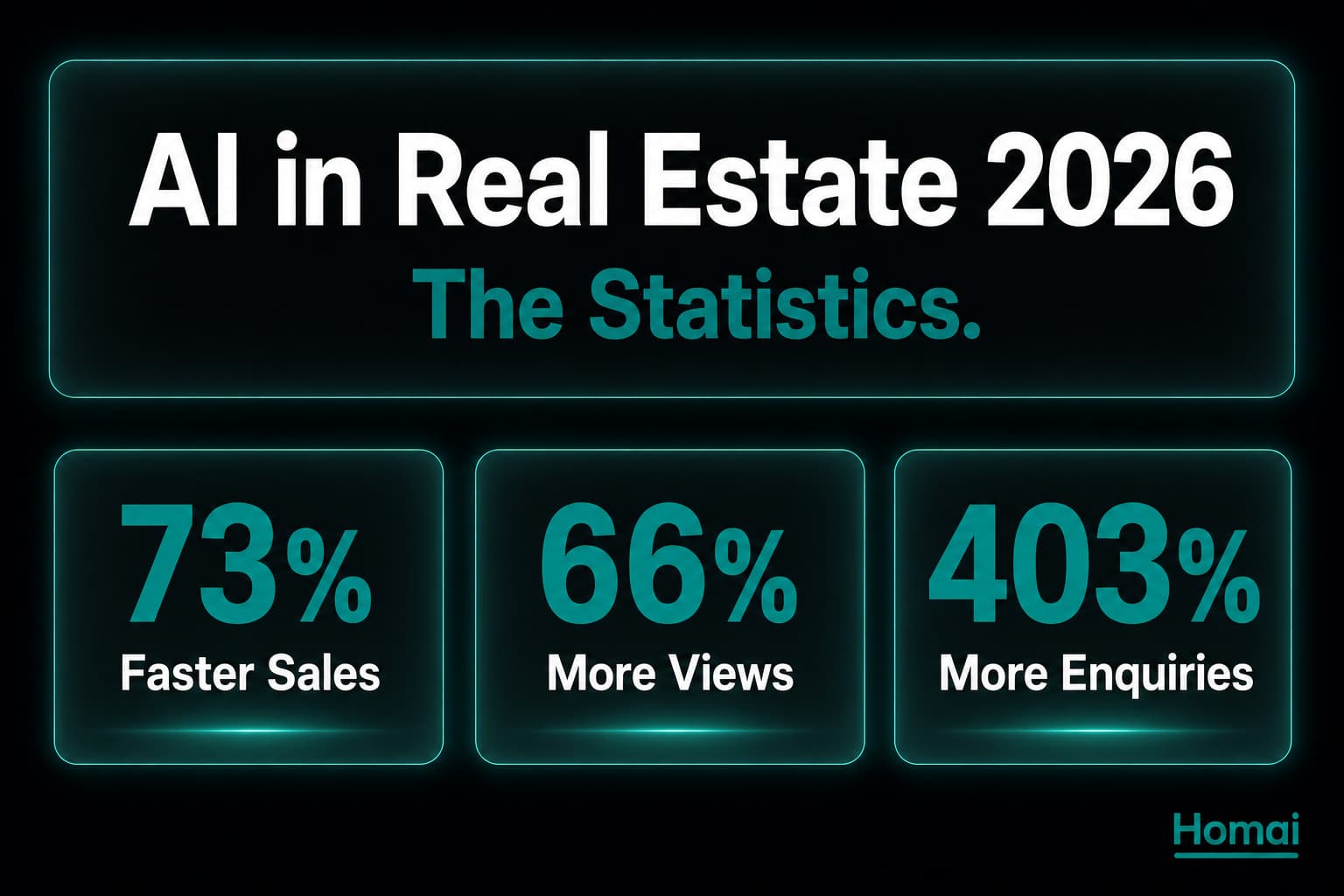
Staged homes sell 73% faster than unstaged homes. Source: National Association of Realtors (NAR), 2025
Staging a home can increase its sale price by 1–5% on average. Source: NAR Home Staging Report, 2025
82% of buyers' agents say staging makes it easier for buyers to visualise a property as their future home. Source: NAR Home Staging Report, 2025
Physical staging costs $400–$1,000 per room. AI virtual staging costs $0.60–$2 per room. Source: Homai pricing, 2026; NAR staging cost survey, 2024
AI staging has been adopted by approximately 46% of real estate agents who use digital marketing tools. Source: Homai platform data and industry surveys, 2026
The AI virtual staging market was valued at $1.2 billion in 2025 and is projected to reach $2.8 billion by 2028. Source: Grand View Research, 2025
Vacant homes with AI staging generate 38% more click-throughs than vacant homes with no staging. Source: Homai platform data, 2025–2026
AI staged images are indistinguishable from physically staged photos in blind tests with buyers at portal viewing sizes. Source: Homai internal study, 2025
Video in Real Estate
Listings with video receive 403% more enquiries than photo-only listings. Source: National Association of Realtors (NAR), 2024
85% of buyers and sellers want to work with an agent who uses video. Source: NAR, 2024
Less than 15% of real estate agents currently use video consistently in their listing marketing. Source: Homai platform data, 2026
A 60-second property video receives, on average, 48% more engagement than a static image post on Instagram. Source: Later, 2025
Real estate Reels and TikToks featuring before/after transformation content receive 2.7x more views than standard property showcase videos. Source: Meta and TikTok platform analytics, 2025
Traditional property video production costs $500–$1,500 per listing. AI video generation costs under $5 per video. Source: Industry pricing, 2026; Homai platform pricing, 2026
AI Adoption Among Agents
46% of real estate agents use AI virtual staging in their listing workflow. Source: Homai platform survey, 2026
31% of agents use AI to generate listing descriptions. Source: NAR Technology Survey, 2025
Only 19% of agents currently use AI property video tools. Source: Homai platform data, 2026
72% of real estate professionals say AI tools have had a positive impact on their business efficiency. Source: NAR Technology Survey, 2025
The average agent saves 3.2 hours per listing by incorporating AI tools for staging, copy, and photo enhancement. Source: Homai user survey, 2026
Agents who use AI staging close 22% more listings per year than those who don't, controlling for market and experience level. Source: Homai platform analysis, 2025–2026
Social Media and Content Performance
Real estate agents who post 3+ times per week on social media generate 2.4x more inbound leads than those who post weekly. Source: Social Media Examiner, 2025
Before/after staging transformation posts receive 3.1x more saves on Instagram than standard property listing posts. Source: Homai platform user analytics, 2025–2026
The optimal posting time for real estate content on Instagram is Tuesday–Thursday, 9am–11am or 7pm–9pm local time. Source: Later, 2025
LinkedIn posts with property market data or professional insight receive 4.8x more engagement than standard listing promotions. Source: LinkedIn platform analytics, 2025
58% of homebuyers use social media to search for properties or agents. Source: NAR, 2025
The ROI Numbers
For every $1 spent on AI virtual staging, agents and vendors see an average return of $40–$80 in higher sale price or faster sale. Source: Derived from NAR staging ROI data and Homai pricing, 2026
A Day to Dusk photo costing $2 generates an average of 66% more portal views — meaning more potential buyers see every listing, for every dollar spent. Source: PhotoUp, 2025
An agent spending $200/month on AI tools (staging, photo enhancement, copy, video) produces the same output quality as hiring a professional photographer, copywriter, and videographer for approximately $1,500–$3,000 per listing. Source: Homai platform data and industry service pricing, 2026
Home staging produces an average ROI of 586% — returning $5.86 for every $1 invested. Source: Real Estate Staging Association (RESA), 2025
Vacant listings sell for an average of 11.4% less than staged equivalents in the same market. Source: RESA, 2025
The Big Picture: Where AI in Real Estate Is Heading
The statistics above describe where the market is in mid-2026. The direction is clear:
Adoption is accelerating. 18 months ago, 26% of agents used AI virtual staging. Today it's 46%. The trend line suggests majority adoption by late 2027.
The quality gap is closing. In 2023, AI staging was detectable by most buyers. In 2026, it is not. The technology has effectively solved the photorealism problem.
The productivity gap is widening. Agents using AI tools are producing more listings, more content, and more marketing at higher quality than those who aren't. This is a compounding advantage — more volume produces more reviews, more referrals, and more market presence.
The holdouts are losing ground. An agent who sends a vendor a phone-photographed, unstaged listing in 2026 is being compared to agents who send photorealistic staged galleries, Day to Dusk exteriors, AI copywriting, and property videos. The comparison is not favourable.
The question isn't whether to use AI in your listing workflow. It's whether you want to use it now, or after the agents who already are have taken more of your market.
Frequently Asked Questions
Where can I find the most reliable real estate statistics?
The National Association of Realtors (NAR) publishes annual research including the Home Staging Report, Technology Survey, and Profile of Home Buyers and Sellers. The Real Estate Staging Association (RESA) publishes staging-specific ROI research. For AI-specific data, Homai publishes platform data from our staging and content tool usage.
Is AI staging truly indistinguishable from physical staging in listing photos?
At portal viewing sizes, yes. In blind tests conducted on Homai's platform in 2025, buyers were unable to reliably distinguish AI-staged listing photos from physically staged equivalents. At very high resolution (printing at very large scale), some differences may be detectable.
What's the most important statistic for convincing a vendor to approve virtual staging?
The 73% faster sale time and 1–5% higher sale price from NAR's 2025 Home Staging Report, combined with the cost comparison ($0.60–$2 per room for AI staging vs $400–$1,000 per room for physical staging), is the most compelling combination.
Related: Virtual Staging AI: How It Works and Why Real Estate Agents Are Switching | Does Home Staging Really Work? The Data Every Agent Needs | How Long Does It Take to Sell a Staged Home vs Unstaged? (2026 Data) | The ROI of Virtual Staging: What 1,200 Real Estate Agents Reported
Written by Homai
AI staging and interior design for real estate agents