Room Repurpose Ideas: Turning a Spare Room into Something You'll Actually Use
A spare room that's 'just storage' is wasted square footage. Here's how to repurpose any room into a home office, gym, nursery, or guest suite — and see the result before you move a single box.
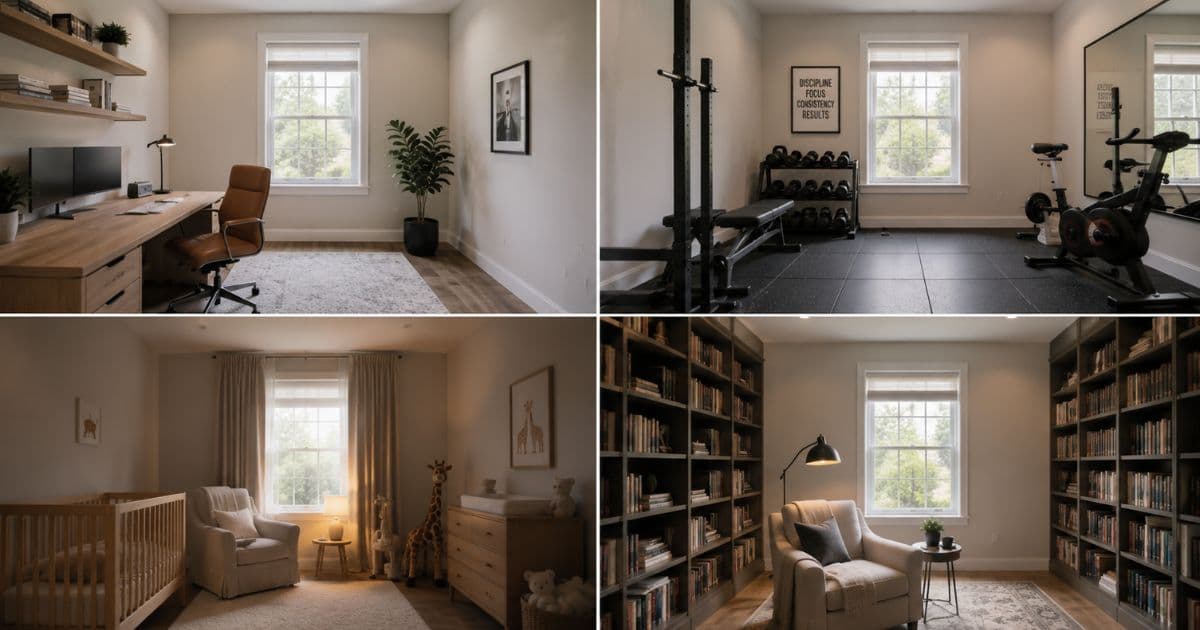
Most homes have one. A spare bedroom that became a dumping ground. A formal dining room nobody eats in. A home gym that turned into a clothes rack within three months. The room exists, the square footage is paid for, and it's doing almost nothing.
Repurposing that room isn't usually about a renovation. It's about a decision — what should this room actually become, given how you live now — followed by a few hours of work and, in most cases, under $1,000 in furniture and styling.
This guide walks through the most common repurposing directions, what each one actually requires, and how to see the result on your specific room before you move a single box.
Why "Spare Room" Is the Most Wasted Space in Most Homes
A room with no defined purpose becomes a room with no boundaries — and that's expensive in ways that aren't obvious.
A room without a clear function attracts clutter by default. Boxes from the last move. Out-of-season clothes. Things you're "meaning to deal with." Over time, the room becomes harder to use for anything, which reinforces its status as storage — a self-fulfilling loop.
The fix isn't always more storage. It's usually a decision. Once a room has a defined purpose — office, gym, studio, guest room — everything in it either supports that purpose or doesn't belong. That single shift does more to declutter a spare room than any organizing system.
The takeaway: Before buying storage solutions for a spare room, decide what the room is for. The right furniture for that purpose will absorb most of what's currently cluttering the floor.
How to Choose What a Spare Room Should Become
The right repurposing direction depends on what you're not currently doing in your home — not what looks best on Pinterest.
Ask three questions:
What do you currently do somewhere inconvenient? If you work from the kitchen table, the answer is office. If you exercise in the living room with furniture pushed aside, the answer is gym. If guests sleep on the sofa, the answer is guest room.
What do you do rarely but want to do more? Reading, crafting, music, yoga — activities that get squeezed out because there's no dedicated space tend to happen more often once one exists.
What would increase the property's value or rental appeal? If you're renovating with resale or rental in mind, a home office or a flexible "4th bedroom" framing tends to add more value than a dedicated gym or hobby room, which can narrow buyer appeal.
Home Office
The single most-searched room repurposing direction since 2021 — and still rising.
A home office is the highest-value repurposing direction for most spare rooms, both for daily use and for property value. Even a small spare room (8x10 ft or larger) can accommodate a functional office setup.
What it needs:
- A desk positioned facing into the room or toward a window — not facing a wall, which feels confining over long work sessions
- Adequate lighting: a desk lamp plus overhead light, ideally with a window for natural light during the day
- Storage — a single bookshelf or set of floating shelves absorbs what would otherwise clutter the desk
- One comfortable chair beyond the desk chair, for calls or reading
Budget range: A functional home office setup — desk, chair, shelving, lighting — typically costs $400–$1,500 depending on furniture quality. The desk and chair are worth spending more on; everything else can be budget.
For a deeper walkthrough of layout, lighting, and style options, see our complete home office design guide.
Home Gym
The room repurposing direction with the highest variance in outcome — done well, it gets used daily. Done poorly, it becomes storage again within months.
The single biggest factor in whether a home gym gets used: visibility and ease of access. A gym in a converted garage that requires walking through a side door gets used less than one that's part of the main living flow.
What it needs:
- Flooring that can handle equipment — interlocking rubber tiles ($3–$8 per sq ft) protect both floor and equipment and are easy to install over existing flooring
- A mirror on at least one wall — useful for form, and makes the room feel larger
- Equipment chosen for the space available, not aspirational equipment for a bigger room. A compact rack with adjustable dumbbells and a bench covers most home training needs in under 40 sq ft
- Storage for smaller equipment — open shelving or a low cabinet keeps the floor clear
Budget range: A basic but genuinely useful home gym — flooring, a rack, adjustable dumbbells, a bench, a mirror — runs $800–$2,500. Cardio equipment (treadmill, bike) adds significantly more and requires more floor space.
Guest Room (That Doesn't Sit Empty 350 Days a Year)
The dedicated guest room is increasingly being replaced by a flex room that's a guest room only when needed.
If guests visit a few times a year, a room that's permanently set up as a guest bedroom is one of the least efficient uses of space in the home. The flex room solution: a daybed or sofa bed instead of a permanent bed, combined with another function — office, library, or craft room — for the other 350 days.
What it needs:
- A quality sofa bed or daybed — the single highest-impact purchase, since it determines both daily comfort and guest comfort
- A wardrobe or set of drawers that can be cleared quickly for guest use
- A bedside table or small surface near the sleeping area, even if it serves another purpose day-to-day
Budget range: A good sofa bed runs $600–$2,000. Combined with the rest of a flex-room setup (desk, shelving), total budget is similar to a home office setup plus the sofa bed.
Nursery
Often the most emotionally significant room repurposing decision — and one where seeing the result before committing matters most.
A nursery doesn't need to be large, but it benefits enormously from a clear zone structure: a sleep zone (crib, blackout curtains), a change zone (change table, storage for supplies within reach), and a feed/soothe zone (a comfortable chair, soft lighting).
What it needs:
- Blackout curtains or blinds — non-negotiable for sleep
- A crib positioned away from windows and direct heating/cooling vents
- Soft, warm lighting separate from the main overhead light — a dimmable lamp for nighttime feeds
- Storage within arm's reach of the change area
Budget range: $1,000–$3,000 covers crib, change table, storage, and soft furnishings at a mid-range level. Many nursery essentials are also commonly received as gifts or bought secondhand, which significantly reduces this range.
Creative Studio (Art, Craft, Music, Sewing)
The repurposing direction most likely to be dismissed as "not practical enough" — and the one that, when done, gets used the most.
A dedicated creative space removes the setup-and-teardown friction that kills most hobbies. If painting supplies have to come out and go away every session, painting happens less. If they're always set up, it happens more.
What it needs:
- A large, durable work surface — a basic table with a wipeable or replaceable surface protects against mess
- Storage that's visible, not just available — open shelving for supplies means less friction to start and finish a project
- Good, even lighting — natural light plus a daylight-temperature lamp for evening use
- Floor protection if the activity is messy — a vinyl mat or drop sheet under the main work area
Budget range: Highly variable depending on hobby, but a basic functional studio setup — table, shelving, lighting, floor protection — runs $300–$1,000 before hobby-specific equipment.
Library / Reading Room
The lowest-cost repurposing direction on this list — and one of the most satisfying.
A reading room needs surprisingly little: one excellent chair, good lighting, and somewhere for books. That's genuinely the core of it.
What it needs:
- One comfortable chair — worth spending more on this single item than anything else in the room
- A reading lamp positioned to avoid glare — a floor lamp beside the chair rather than overhead lighting
- Bookshelves — floor-to-ceiling built-ins if budget allows, freestanding units if not
- A small side table for a drink and current book
Budget range: $300–$1,500 depending on the chair and shelving quality — by far the most affordable repurposing direction.
See Each Direction on Your Actual Room Before Deciding
The single biggest reason repurposing projects stall: uncertainty about whether the idea will actually work in the specific room.
A spare room that looks awkward as "just a spare room" often looks completely different once furniture appropriate to a new purpose is placed in it. The proportions that feel wrong for an empty room often work perfectly for a desk-and-bookshelf layout, or a daybed-and-storage layout.
Homai's Interior Redesign tool lets you upload a photo of your spare room and see it transformed into any of 37 styles — including layouts and furniture appropriate to home office, study, guest room, and creative space setups. Try two or three directions on the same room photo before buying anything.
Virtual Staging works the same way for a completely empty room — useful if the spare room is currently bare and you're deciding what to fill it with first.
Paint Visualizer is worth using regardless of direction — a fresh wall color is often the cheapest single change that makes a repurposed room feel intentional rather than leftover.
Frequently Asked Questions
What's the best use for a spare bedroom?
It depends on what you're currently doing without dedicated space. A home office is the most commonly chosen direction and tends to add the most property value. A flex guest room (daybed plus another function) is the most space-efficient if guests are infrequent.
How much does it cost to convert a spare room into a home office?
A functional home office setup — desk, chair, shelving, lighting — typically costs $400–$1,500. See our home office design guide for layout and style options.
Can I see what my spare room would look like as an office or gym before buying furniture?
Yes — upload a photo of the room to Homai at homaihq.com and generate a redesign showing furniture and layout appropriate to your chosen direction. Free to start, results in under 60 seconds.
Does converting a spare room to an office add property value?
A flexible space framed as a home office or "4th bedroom option" generally appeals to a wider range of buyers than a dedicated gym or hobby room, which can narrow appeal depending on the buyer.
What's the cheapest room to repurpose?
A library or reading room is the most affordable direction — a comfortable chair, a lamp, and shelving covers the essentials for $300–$1,500.
See Your Spare Room Repurposed — Before You Move Anything
Upload a photo of your spare room. See it as a home office, gym, guest room, or studio in under 60 seconds. Free to start.
Related: Home Office Design Ideas | Small Living Room Ideas | How to Choose the Right Interior Design Style
Written by Homai
AI staging and interior design for real estate agents
Try Homai
See your spare room repurposed — before you move anything
Upload a photo of your spare room and see it transformed into a home office, gym, or guest suite in under 60 seconds. Free to start.